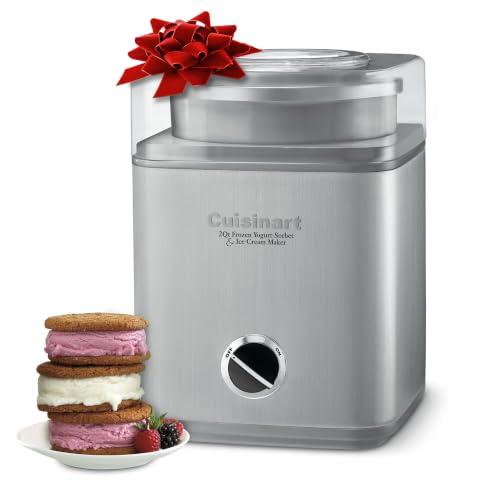
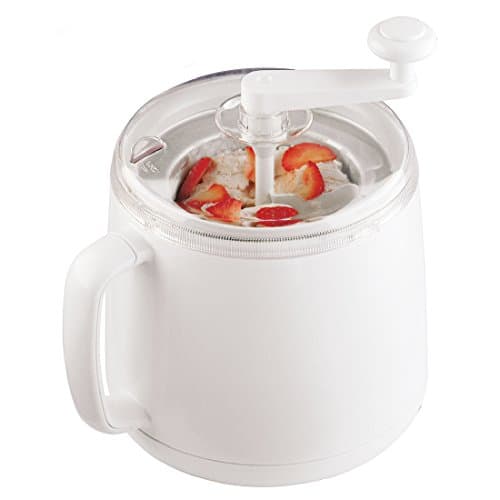
Spend around $70 on a 2-quart Cuisinart ICE-30BCP1 and stop reading. It is the most machine per dollar under $200: two quarts a batch, a brushed stainless housing, an America's Test Kitchen Recommended verdict at a listed $100 in June 2026, and an Ice Cream Science owner who reports about seven years of use out of one. Nothing else in this band combines capacity, evidence and price like that.
The one thing $200 does not buy is a compressor. Every self-refrigerating machine we cover prices above this line, and the cheapest of them is not far above it. That single fact shapes the whole page: under $200 you are choosing which kind of waiting you accept, not whether you wait. A canister machine wants its bowl frozen 16 to 24 hours ahead. A pint machine wants the dessert itself frozen overnight. A bucket machine wants ice and rock salt bought on the day. There is no fourth option at this price.
What $200 actually buys, and what it does not
Prices in this category move constantly, so treat the band as a shape rather than a list. As we write, nine machines in our registry carry a live Amazon price under $200 and none of them has refrigeration. What the money does buy, in rough order of how much it changes your evening:
- Real capacity. Two quarts from a canister machine, four from a bucket. This is the single biggest difference between the top and bottom of the band, and it is why we do not rank the pint machines first.
- Published, independently measured performance. Two machines under $200 have numbers from a named third party behind them. The rest have manufacturer specs and nothing else.
- A timer and auto shut-off, which matters more than it sounds, because over-churning is one of the two most common ways a first batch goes wrong.
- A second container, on one of the pint machines, so two flavors can sit frozen at once.
What it does not buy: back-to-back batches, deciding at seven and eating at eight, a gelato paddle, a yogurt incubator, or a bowl whose material the manufacturer will actually confirm. Those all live above the line, and the honest comparison is in what the money buys between budget and premium.
How we ranked them
Four tests, applied in this order. They are deliberately not the same tests we would use above $300, because at this price the failure modes are different.
- Usable quarts per dollar, not rated quarts. A rated capacity is the bowl volume; the usable figure is roughly two thirds of it, because churning folds in air and an overfilled bowl climbs the paddle. The arithmetic is in what size ice cream maker you need.
- Whether anyone independent has measured it. We do not run a test kitchen, so a machine with a published third-party result outranks an identically specified machine without one. Our methodology explains the weighting.
- What the waiting actually costs you. A frozen bowl occupies a freezer shelf permanently. A frozen pint occupies it only until you eat it. Ice and rock salt occupy no freezer space but cost money every batch.
- Honest running costs. Consumables, a second bowl, a second pint container - all of it is part of the price, and cost per batch is where we keep the numbers.
The compressor line, and why we keep pointing at it
If the thing you actually want is to make ice cream on impulse, no machine on this page will do it and you should save up rather than settle. The cheapest self-refrigerating machine in our registry is the Whynter ICM-220CGY, which as we write sits a little above $200 - closer to this band than most people assume. Stretching to it buys 2.1 quarts, batches back to back and no freezer shelf given up permanently. The case either way is in compressor versus freezer bowl and the compressor roundup.
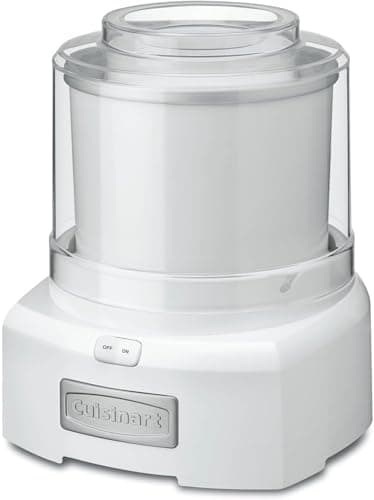
1. Cuisinart ICE-30BCP1: the best machine under $200
Two quarts, 16 to 24 hours of pre-freeze, about 20 to 25 minutes of churning, and a brushed stainless housing. ATK put it in Recommended at a listed $100 in June 2026. Ice Cream Science, who have owned one for roughly seven years, rate the output smooth and creamy with minor icy bits - which is a fair description of what any canister machine does and an unusually long service record to have on the public internet.
It wins because two quarts is a genuinely useful batch. That is dessert for a table with leftovers, where a pint machine is dessert for two and a second pint is another overnight wait. At the price it currently carries, nothing else in the band is close on capacity per dollar with evidence attached.
The honest cons. The bowl lives in your freezer, permanently, and it is not a small object - that is a real cost in a full freezer. One batch per day unless you buy a second bowl, because the bowl has to refreeze completely. There is no timer, so you judge the end point by eye and by sound. And Cuisinart does not publish what the bowl is lined with; the “brushed stainless” in the name is the outer housing.
Also worth knowing: the 1.5-quart Cuisinart ICE-21P1 is the machine ATK actually named their best canister-style pick, at a listed $70 in June 2026, and it is our overall site-wide recommendation. It sits in this band too whenever Amazon has a price for it. Half a quart less, same mechanism - the two are compared directly in ICE-21 versus ICE-30.
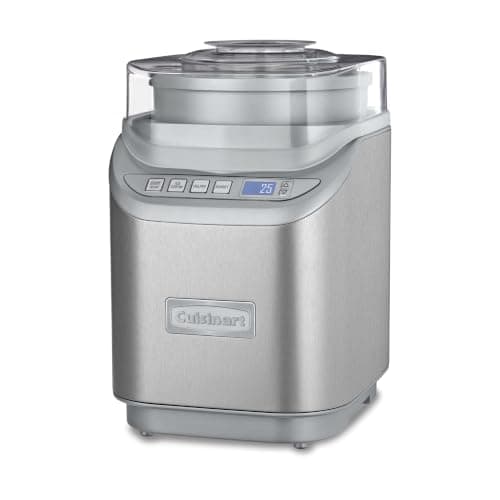
2. Cuisinart ICE-70P1: the best measured texture in the band
The same 2 quarts with a countdown timer, automatic shut-off and three texture programs. The reason it is here rather than further down is Ice Cream Science's measurements: a 28 minute 30 second churn, a 900 ml optimal fill, and output they rated excellent with very few coarse bits - their best assessment of any canister machine. That is the strongest texture evidence available anywhere under $200.
The timer is the practical upgrade. Over-churning is how a good base turns buttery, and a machine that stops itself removes the one judgment call a beginner is least equipped to make. If you want to understand what you are judging, how long to churn covers it.
The honest cons. It costs meaningfully more than the ICE-30 for the same capacity, and the 900 ml optimal fill is well under the 2-quart rating - so the real batch is smaller than the box implies. Same permanent freezer-shelf tax, same one-batch-a-day limit, same unpublished bowl lining. The three texture programs are a convenience rather than a different dessert.
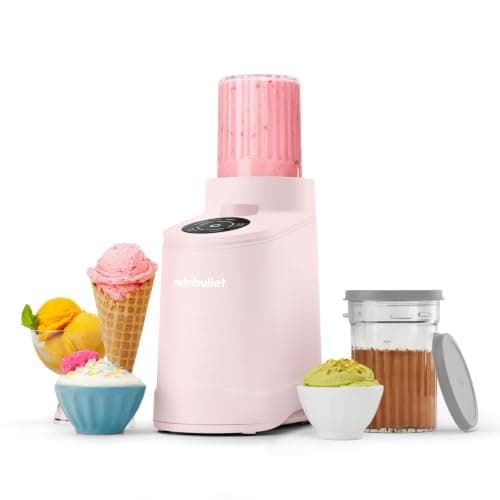
3. nutribullet Chill: the best pint machine under $200
If you want the frozen-pint workflow - blend a base, freeze it solid, spin it into ice cream on demand - this is the one to buy under $200. Five programs, 10.49 lb, 5.74 inches wide. It is the only machine of its type whose manufacturer publishes a complete dimension and weight set, which on a counter-space decision is the number that matters.
The pint format genuinely suits some households better than a tub: you never make more than you can eat fresh, lean and high-protein bases behave better under a blade than under a paddle, and nothing permanent lives in your freezer. The mechanics are in how a spin machine works.
The honest cons. One pint per spin is two servings - a fifth of what the ICE-30 makes in a single batch. The base still has to freeze overnight, so this moves the waiting rather than removing it. No lab we cite has tested it. And the whole category depends on your base being built to be shaved rather than churned, which is a learning curve the full Chill review and CREAMi alternatives both get into.
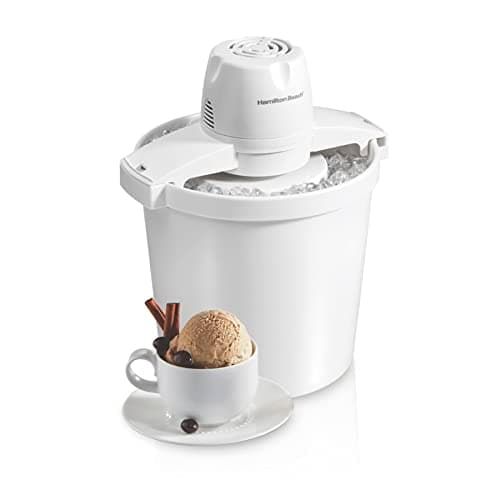
4. Hamilton Beach 68330N: the budget pick, and the volume king
Four quarts for the least money of any machine in our registry. An 80-watt motor turns the canister inside a bucket of ice and rock salt, and Hamilton Beach says it churns for 20 to 40 minutes and stops when the mixture is ready. If the brief is “most ice cream, least money,” this is the answer and it is not close.
It is also the only machine on this page with no freezer-planning problem at all. Nothing is pre-frozen. You buy a bag of ice on the day and go. For a party, a reunion or a hot weekend that is a genuine structural advantage over everything above it here.
The honest cons. Ice and rock salt every single batch is a real running cost and a real mess, and it belongs near a sink or a garden tap - how much salt an ice cream maker needs has the ratio. The result comes out soft and wants a few hours in the freezer to harden. ATK rated a different Hamilton Beach machine, not this one, so there is no independent verdict on it. Hamilton Beach does not publish the canister or paddle material. And four quarts is a large object to store for something you may use three times a summer.
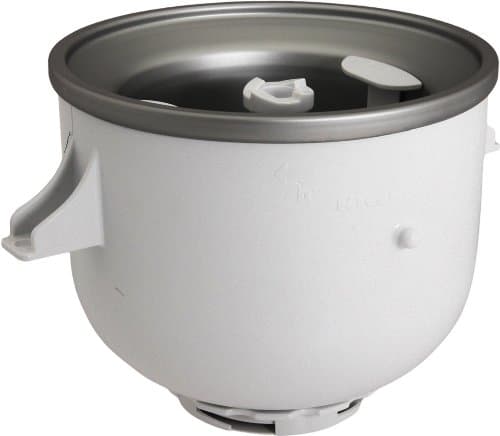
5. KitchenAid ice cream maker attachment: free counter space
Two quarts at soft-serve consistency, driven by a mixer you already own, and nothing new to store except a bowl. KitchenAid asks for at least 24 hours of pre-freeze and says it fits every model except the Artisan Mini 3.5 quart, with some tilt-head models needing the adapter ring - check yours before ordering.
The arithmetic only works if the mixer is already on the counter. If it is, this is the cheapest two quarts in the band with no additional footprint whatsoever, and that is a real argument. If it is not, buying a mixer to get an ice cream maker is the most expensive route to ice cream on this entire site. The comparison is in attachment versus a standalone machine.
The honest cons. A 24-hour minimum pre-freeze is the longest on this page. The bowl is hand-wash only. It ties up your mixer for half an hour. Soft-serve consistency means it wants freezer time to firm up. And you cannot use it at all without the right mixer.
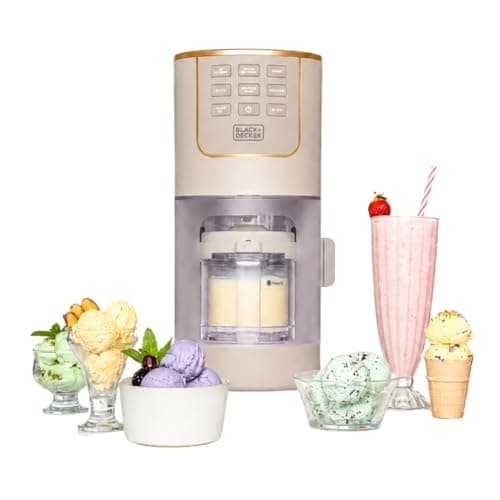
6. BLACK+DECKER Perfect Pint: two containers in the box
The other frozen-pint machine under the line, and its argument over the Chill is what comes in the box: two 1-pint containers, so two flavors can sit frozen and ready. Six named programs plus a mix-in cycle and a labeled Re-Spin pass, in roughly 12 by 7 inches per TechEBlog's July 2026 hands-on.
The Re-Spin button is the genuinely well-chosen feature. Spin machines fail by cutting a frozen block into powder instead of cream, and a second pass over an already-softened block is the fix. Naming it saves a first-time buyer from concluding the machine is broken.
The honest cons. BLACK+DECKER publishes no wattage, which on a machine whose whole job is driving a blade through ice is the specification that matters most. No lab we cite has rated it. TechEBlog puts it at about 19 pounds, which is heavy for a pint - the Chill makes the same amount at 10.49. Full detail in the Perfect Pint review and CREAMi versus Perfect Pint.
7. Donvier 837450: the one that needs no outlet
A freezer-bowl machine with the motor removed. The Chillfast cylinder goes in the freezer overnight, the base goes in, and you turn a light handle occasionally for twenty minutes or less. Cuisipro quotes 1 quart / 0.9 liter, 6.86 lb, dishwasher safe on the top rack. It needs no electricity, no ice and no rock salt, and it is the only machine here that needs none of the three.
It is on the list because that combination is genuinely unavailable elsewhere at any price: a boat, a cabin, a kitchen with no free outlet, or a household that simply wants the quietest possible machine. See the Donvier review.
The honest cons. You have to stay at the counter and keep turning the handle for the whole batch, which a small motor removes entirely. One quart is the ceiling and there is one cylinder in the box. No lab has rated it, and the only hands-on account we could find is from 2018. For most buyers the ICE-30 at a similar price is the better machine.
Also under the line, and why they are not ranked higher
Cuisinart FastFreeze Max (ICE-FD50) - a 1-pint spin machine with 350 W and about 6 inches of counter width per Target's spec panel, which makes it the narrowest real machine we cover. It is a sensible buy for a very tight kitchen and it is ranked below the Chill only on the Chill's fuller published spec set. See the FastFreeze Max review.
YayLabs SoftShell Ice Cream Ball - a 9.5-inch ball with ice and rock salt at one end. It makes real ice cream, but somebody rolls it for 15 to 30 minutes with a scrape and a re-ice halfway through. Buy it for the activity, not as an appliance - the ice cream ball roundup is honest about which group you are in.
Cuisinart FastFreeze (ICE-FD10) - we leave it off deliberately. ATK measured its working capacity at about a quarter of a quart and placed it in Not Recommended. The Max is the usable size in that family, and the ICE-FD10 review explains why.
The decision in six lines
- You want the most machine for the money: Cuisinart ICE-30BCP1. Two quarts, ATK Recommended.
- You want the best texture evidence: Cuisinart ICE-70P1, on Ice Cream Science's measurements.
- You want pints, not a tub: nutribullet Chill, or the Perfect Pint if two containers matter more than published specs.
- You want the cheapest route, or four quarts: Hamilton Beach 68330N.
- A KitchenAid is already on your counter: the attachment, for two quarts and no new footprint.
- You want to make ice cream on impulse: nothing here. Save for a compressor.
If $200 is more than you meant to spend, the under-$100 roundup covers the tighter band, and best for the money ranks the whole registry on cost per usable quart. If you have not settled on a machine type at all, the beginner roundup is the better starting point.