Buy the Ninja CREAMi if you want the machine that has been measured. Ninja publishes 800 watts, America's Test Kitchen rated it in June 2026, Ice Cream Science lived with one for ten weeks, and its recipe library is the largest in this category by a wide margin. On a machine whose only job is driving a blade through a frozen block, a published motor figure and an independent texture verdict are the two things worth paying for.
Buy the BLACK+DECKER Perfect Pint if price is the constraint and a familiar brand matters more than a spec sheet. It does the same job, ships two pint containers, puts a labeled button on the one thing that actually goes wrong with spin machines, and sits in a smaller footprint. You are buying it without a wattage figure and without any lab result, and you should know that going in rather than discover it later.
These two machines are more alike than any other pair on this site. Both are spin machines, not churners: you blend a base, fill a container to the brim, freeze it solid overnight, lock it under a motor and let a paddle shave the block into something scoopable. Neither has refrigeration. Neither has a freezer bowl. Neither saves you any planning. The mechanism is in how a spin machine works, and it is identical on both.
Side by side
| Spec | 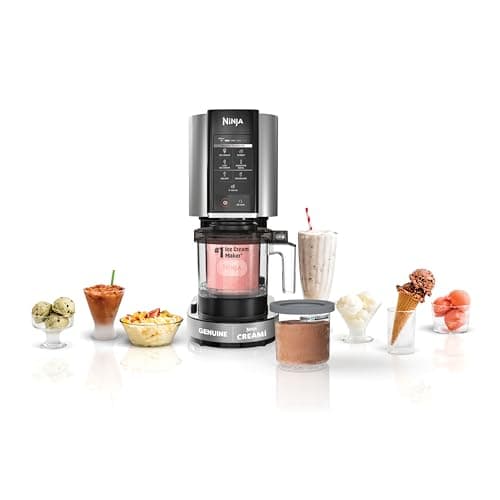 | 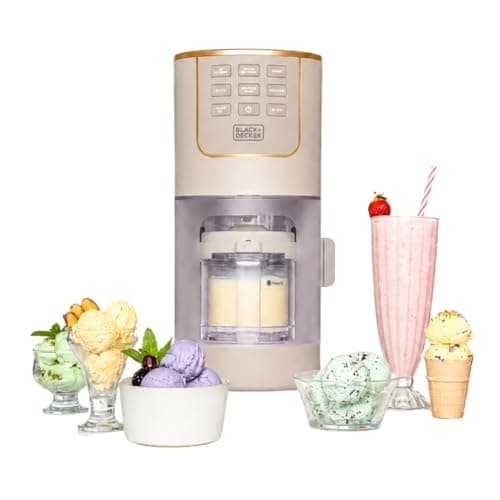 |
|---|---|---|
| Mechanism | Spin / blade, frozen base | Spin / blade, frozen base |
| Model | NC301 (7-in-1) | IC002-21BD |
| Capacity | 16 oz pint, two included | 1 pint, two included |
| Published power | 800 W | Not published |
| Programs | 7 one-touch | 6 named, plus mix-in |
| Re-spin pass | Yes | Yes, a labeled button |
| Pre-freeze | Overnight, filled to the brim | Overnight, filled to the brim |
| Spin time | One spin per pint | ~3 min, then an automatic pause (TechEBlog) |
| Dimensions | 17.44" L x 8.58" W x 18.39" H | About 12" x 7" (TechEBlog) |
| Weight | Lighter than the NC701's 22.2 lb | About 19 lb (TechEBlog) |
| Independent testing | ATK Recommended with Reservations, June 2026; Ice Cream Science 10-week test | None we can cite |
| Recipe ecosystem | The largest of any spin machine | New and small |
| Ice or rock salt | None | None |
| Price |
The missing wattage is the whole argument
A churning machine has to stir a liquid. A spin machine has to cut a solid. That is a fundamentally harder mechanical job, and it is why this category's motors are rated in hundreds of watts while a freezer-bowl machine gets by on fifty. Ninja publishes 800 W on the NC301 and the same figure on the NC501. BLACK+DECKER publishes nothing.
We are not going to estimate it, and we are not going to assume it is low. What we will say is that the absence is itself informative: a motor figure is cheap to publish when it flatters you. Without it you cannot place the Perfect Pint anywhere on the ladder in ice cream maker wattage, which means you cannot predict how it behaves on the bases that are hardest to shave - the lean, high-protein, low-sugar ones that freeze hardest.
That matters more than it sounds, because lean bases are exactly what people buy these machines for. The CREAMi took the protein-ice-cream niche precisely because 800 watts will cut a block with almost no fat in it. If that is your use case, you are choosing between a known quantity and an unknown one. The bases themselves are in a tested protein base and the protein ice cream roundup.
One machine has been tested. The other has not.
America's Test Kitchen placed the CREAMi in Recommended with Reservations at a listed $207 in June 2026 - a qualified verdict, not a rave, and we quote it as one. Ice Cream Science ran one for ten weeks and came away positive on convenience and footprint. For the BLACK+DECKER Perfect Pint there is no lab result at all: ATK's June 2026 review does not include it, Ice Cream Science has not covered it, and the only hands-on we could read is TechEBlog's July 15, 2026 write-up, which reports a smooth result and an even mix-in distribution but is not a controlled test. Our methodology explains why a qualified verdict still outranks no verdict.
Re-Spin: the same feature, named differently
Both machines have it, and on both it is the single most useful control on the panel. Spin machines fail one way: the blade cuts a powder instead of a cream, because the base was too hard, too cold or too lean. The fix is a second pass over a block the first pass has already broken up. Ninja calls it Re-spin and gives it a program. BLACK+DECKER calls it Re-Spin and gives it a button.
So this is not a differentiator, and anyone selling it to you as one is overreaching. What is worth noting is that neither machine's re-spin is a cure - it is a rescue. The underlying problem is almost always the recipe, and the real fixes are more fat, more sugar or a stabilizer. That is the subject of why homemade ice cream comes out crumbly and stabilizers in ice cream.
Counter space goes the other way
This is the Perfect Pint's clearest win, and it is a real one. The NC301 is 18.39 inches tall, which means it will not stand under a standard wall cabinet - you lift it out to use it, which for a machine you are meant to reach for on impulse is a genuine friction. TechEBlog puts the Perfect Pint at roughly 12 by 7 inches.
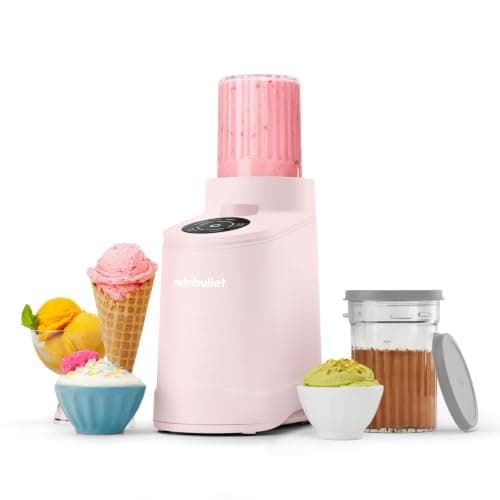
Weight cuts the other way slightly. About 19 pounds for a 1-pint machine is heavy, and the nutribullet Chill makes the same quantity at 10.49 pounds in a 5.74-inch width. If the real constraint is a small kitchen rather than a small budget, the Chill is the machine to look at first, and the arithmetic for tight counters is in best machines for small spaces.
The recipe library is a hardware feature here
On a churning machine, a recipe is a recipe: any custard base will churn. On a spin machine it is not that simple, because the base has to be built to be shaved rather than whipped - it has to freeze to a block that a blade can cut into cream rather than into gravel. Fat, sugar and solids all behave differently under that constraint than they do in a canister.
The CREAMi has had that problem solved for it thousands of times over by a user base measured in millions of machines, and that body of tested bases transfers directly to a buyer's first week. The Perfect Pint, as a 2026 arrival, has almost none of it yet - and because the two machines are not identical in power or paddle geometry, CREAMi recipes are a starting point rather than a guarantee. Treat the library as a specification, not a bonus. Our own starting points are the CREAMi vanilla base and custard versus Philadelphia.
What neither machine fixes
The overnight freeze. Both of these are often sold as the machine that removes the waiting, and neither does - they move it. There is no bowl to pre-freeze, no ice and no rock salt, but the dessert itself has to be frozen solid before the machine can touch it, so dessert at 8pm is a decision you made at 8pm yesterday. Only a compressor machine removes the wait, which is the argument in compressor versus freezer bowl.
And volume. A pint is dessert for about two people, on either machine. Two containers means two overnight freezes, and a table of four is a two-container job planned a day ahead. A Cuisinart ICE-21P1 makes 1.5 quarts in one run - roughly six times as much - and was ATK's best canister pick at a listed $70 in June 2026. If you are feeding people rather than feeding yourself, neither of these machines is the answer; the family roundup is.
The verdict
- You want the machine with evidence: Ninja CREAMi. Published 800 W, an ATK verdict and a ten-week independent test.
- Lean, high-protein or low-sugar bases are the point: CREAMi, for the known motor and the tested recipes.
- Price is the constraint: Perfect Pint. Same workflow, two containers, a mainstream brand's service network.
- A wall cabinet is your constraint: Perfect Pint at roughly 12 by 7 inches. The CREAMi's 18.39 inches will not clear it.
- The kitchen is genuinely tiny: neither - the nutribullet Chill, at 10.49 lb and 5.74 inches wide.
- You are feeding four or more: neither. A 1.5-quart canister machine.
Both get the full treatment in the Ninja CREAMi review and the Perfect Pint review. If you have not decided on a spin machine at all yet, start with the types explainer, and CREAMi alternatives lines up every rival in the category side by side.