For most households the answer is 1.5 quarts, and the reason is not capacity — it is that homemade ice cream is at its best for two or three days, so a bigger batch mostly buys you worse ice cream later. One quart of usable output is dessert for about four people. If there are two of you, a 16-ounce pint machine is the better shape. If you are feeding eight or more, you need a bucket machine, and nothing in the mainstream 1.5-to-2 quart range will do it.
Here is the arithmetic that gets you from the number on the box to the number of bowls on your table.
Rated capacity is not usable capacity
Every machine in this category is sold on a rated capacity, and that figure is the point at which the churning mixture — which expands as air works into it — climbs out of the bowl. It is a ceiling, not a target. Practical fill is roughly two thirds.
Ice Cream Science is more specific, and its numbers are the most useful in the niche because they come from actually filling the machines. It puts the optimal fill of the 2-quart Cuisinart ICE-70P1 at 900 milliliters — under half the rating — and the 1.5-quart Lello 4080 at 700 milliliters. Both are machines whose owners are trying to get the best texture, not the biggest tub, and that is exactly the trade.
Why under-filling makes better ice cream
Less mixture against the same cold surface freezes faster, and a faster freeze grows more and smaller ice crystals, which is what you taste as smooth. Over-fill a machine and you get a slower freeze, a laboring motor and a coarser result — the same mechanism behind icy homemade ice cream. So the honest reading of a capacity spec is: buy for the batch you want to eat, and run the machine below its rating.
How many people each size actually feeds
A normal dessert serving of ice cream is about half a cup, and a quart is four cups, so a quart is roughly eight small servings or four generous ones. Apply the two-thirds rule and the category looks like this.
- 16 oz pint (spin machines): about 1 to 2 servings. One or two people.
- 1 cup (DASH My Pint): about 1.6 cups finished per the manufacturer. One person, one dessert.
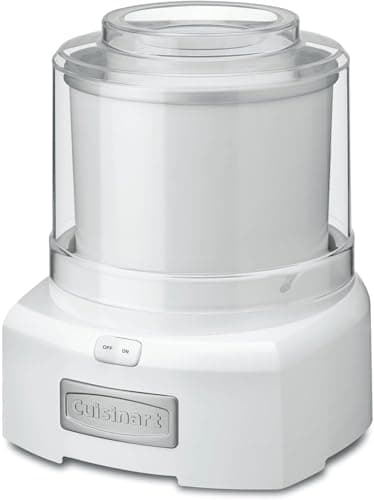
- 1.5 qt (Cuisinart ICE-21, ICE-100, Breville, Lello): about a quart usable. Four people generously, six at a push.
- 2 qt (Cuisinart ICE-30, ICE-70, KitchenAid attachment): about 1.3 quarts usable. Five to six people.
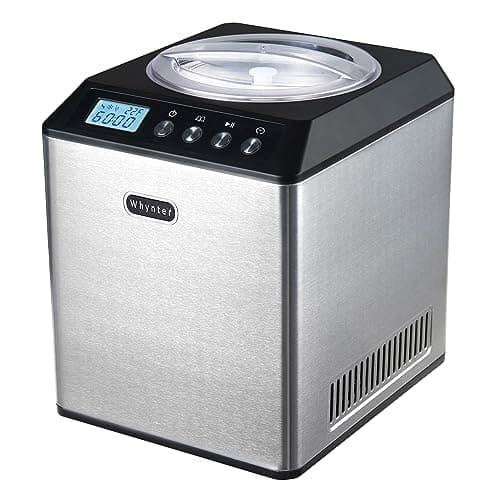
- 2.1 qt (Whynter ICM-201SB, ICM-220CGY): about 1.4 quarts usable, and no pre-freeze, so you can run it twice. Six to eight people.
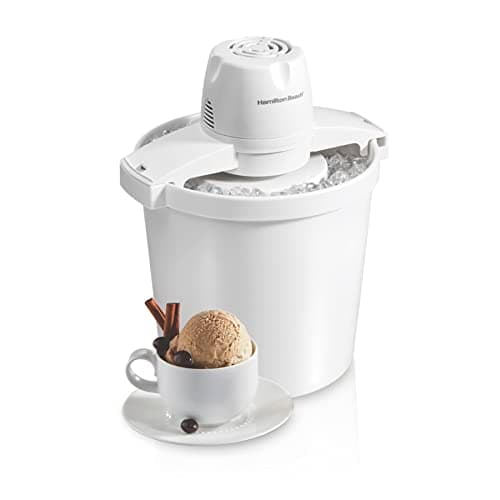
- 4 qt (Hamilton Beach 68330N): about 2.7 quarts usable. Ten to twelve people.
- 6 qt (Nostalgia ICMP600WD, Immergood): about 4 quarts usable. A reunion.
Note where the step changes are. Between 1.5 and 2.1 quarts you are arguing about one or two extra bowls, which is rarely worth paying for; from 2.1 to 4 quarts you double the party. The full set of machines at the top end is in the big-batch roundup.
The reason bigger is usually wrong
Homemade ice cream contains no stabilisers or emulsifiers, which is most of why it tastes better than a tub, and all of why it does not keep. It is excellent for two or three days and noticeably worse after a week: every small warming and refreezing moves water onto larger crystals and the texture coarsens. A frost-free freezer, which cycles deliberately, speeds it up.
So a 4-quart batch for a household of three is not four times the dessert. It is one good weekend and then a fortnight of declining ice cream. The capacity worth buying is the amount your household eats in about three days, and that is a smaller number than most people guess. What you can do to slow the decline is in storing homemade ice cream.
Think in batches per week, not liters per batch
The more useful question than “how big” is “how often,” because that is what the mechanism decides.
A freezer-bowl machine makes one batch and then needs 16 to 24 hours to refreeze its bowl. So its real capacity is not 1.5 quarts, it is 1.5 quarts per day, and a spare bowl doubles that for very little money — the cheapest capacity upgrade in the category, and the only one that also gets you two flavors in an evening.
A compressor machine can run batches back to back indefinitely. The Lello 4080's manufacturer quotes up to 3 quarts per hour. That makes a 1.5-quart compressor functionally larger than a 2-quart canister machine, which is the single most overlooked fact in this whole comparison. The mechanism behind it is in compressor versus freezer bowl.
A spin machine makes one pint per run, as fast as you can feed it frozen pints. Its capacity is however many pints are in your freezer, which is a planning decision rather than a hardware one.
The capacity nobody prices in
Every size on this page costs freezer space somewhere, and that is often the binding constraint rather than counter space.
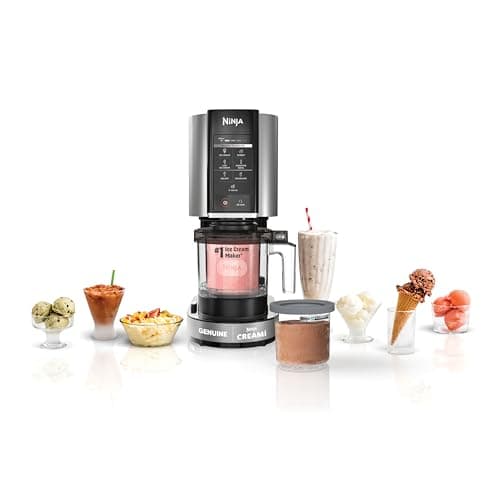
A canister bowl wants a permanent shelf if you want to stay ready. A KitchenAid KICA0WH bowl is larger still and wants at least 24 hours of pre-freeze per the manufacturer. A CREAMi stocked with four pints is four pints of freezer volume. A compressor machine is the only type that needs none at all, which is part of what you are buying with it — and it takes that space back on your counter, 16.73 inches deep in the Cuisinart ICE-100's case.
What to buy, by household
- One person: a 16-ounce pint machine, or a 1-cup machine if you want genuinely single portions. See the small-household roundup.
- Two people: 16-ounce pints, because several flavors beats one tub. Or 1.5 quarts and halve the recipe.
- Family of three to five: 1.5 quarts. This is the size the category is built around and the Cuisinart ICE-21P1 is ATK's best canister-style pick at $70 in June 2026.
- Five to eight, or you entertain: 2.1 quarts with no pre-freeze, so you can run it twice in an evening. The Whynter ICM-201SB was ATK's best self-refrigerating machine at $310.
- A party, a few times a year: 4 to 6 quarts in an ice-and-salt bucket. The Hamilton Beach 68330N is the cheapest capacity on this site, and you buy ice and rock salt every batch — see how much salt you need.
One last piece of advice that saves more money than any size calculation: if this is your first machine, buy 1.5 quarts even if you think you want more. It is the size with the best machines, the lowest prices and the most recipes written for it, and the only way to find out how much ice cream your household really eats is to make some. When you know, how to choose an ice cream maker handles the rest of the decision.