Buy the BLACK+DECKER Perfect Pint if you want a frozen-pint machine from a brand with a service network, and the Re-Spin button is what sells it. Spin machines do not churn a liquid; they shave a solid block, and the single most common failure is a first pass that comes out crumbly rather than creamy. Most machines leave you to work out what to do about that. This one has a labeled cycle for it.
Do not buy it for the specification sheet, because there barely is one. BLACK+DECKER publishes no wattage, which on a machine whose entire job is driving a blade through ice is the number that matters most, and no testing lab we are willing to cite has rated it. Everything below is either the Amazon listing's own feature panel or TechEBlog's hands-on from July 2026, labeled as such throughout. Our methodology explains how thin evidence constrains the scores.
What it is, mechanically
A spin machine, the newest of the categories in our types explainer. There is no refrigeration and no freezer bowl. You blend a base, fill a pint container to the brim, freeze it overnight, then lock it under the machine and a paddle clipped to the lid shaves the frozen block into something smooth. TechEBlog puts the actual spin at about three minutes, after which the machine pauses automatically.
That is the same principle as the Ninja CREAMi, and the same trade comes with it: a spin machine moves the waiting rather than removing it. Nothing permanent lives in your freezer, no ice and no rock salt is involved, and there is no stirring while it freezes. But the base has to be frozen through first, so dessert is still a decision you made yesterday. What you get in exchange is that the frozen thing in your freezer is the dessert itself rather than an empty bowl. The physics is in how a spin machine works.
The Re-Spin cycle, and why it is a real feature
When a spin machine fails, it fails in one specific way: the blade cuts a powder instead of a cream. That happens when the base is too hard, too lean or too cold, and the honest fix is to run it again — the second pass works a block that the first pass has already softened and broken up. BLACK+DECKER calls that Re-Spin and gives it a button.
Two things worth being clear about. First, this is not unique technology; it is a named, documented cycle for something experienced users of every spin machine already do by hand, and naming it is genuinely useful for a first-time buyer who would otherwise conclude the machine is broken. Second, it is a symptom-level fix. The underlying problem is usually the base recipe, and the real cure is more fat, more sugar or a stabilizer — which is the subject of why homemade ice cream comes out crumbly and stabilizers in ice cream. Re-Spin rescues a batch; a better base means you do not need rescuing.
The published numbers, and the missing one
From the Amazon listing read on October 26, 2026, and TechEBlog's hands-on of July 15, 2026:
- Model: IC002-21BD.
- Capacity: 1 pint per container, with two containers included, and TechEBlog confirms you can fill both.
- Programs: ice cream, sorbet, gelato, yogurt ice cream and milkshakes, plus a mix-in cycle and the Re-Spin pass.
- Spin time: about three minutes, then an automatic pause.
- Pre-freeze: overnight, filled to the brim, no ice, no salt, no stirring.
- Footprint: about 12 by 7 inches per TechEBlog.
- Weight: about 19 pounds per TechEBlog.
- Power: not published.
We are not going to estimate the wattage, and you should treat its absence as information. On a machine that shaves ice, motor strength is the difference between a creamy pass and a stalled one — Ninja publishes 800 W on the NC501 and NC701, and the Cuisinart FastFreeze Max lists 350 W on Target's panel. BLACK+DECKER listing nothing means you cannot place this machine on that ladder at all, which is the argument in ice cream maker wattage.
The weight figure is the other one to sit with. About 19 pounds for a 1-pint machine is heavy — the nutribullet Chill makes the same amount at 10.49 pounds. Weight is not a fault in itself, and a heavier body usually means a more planted machine under load, but it does decide whether an appliance lives on the counter or in a cupboard.
No independent testing exists for this model
America's Test Kitchen's June 2026 ice cream maker review does not include the Perfect Pint, and Ice Cream Science's machine reviews do not cover it. TechEBlog's piece is a hands-on write-up rather than a lab test: it reports a smooth, scoopable result and an even mix-in distribution, describes the controls as basic and the build as reasonably sturdy, and that is the full extent of third-party evidence we could read. We score it on that plus the manufacturer's own feature list, which is why the texture number is mid-range rather than high.
The protein and dairy-free claims, read honestly
BLACK+DECKER markets this machine around high-protein, keto and dairy-free bases, and the claim is reasonable rather than cynical: a spin machine genuinely handles a lean mixture better than a churning one, because it is cutting a solid rather than trying to whip a liquid that has no fat to hold air. That is the same reason the CREAMi took over the protein-ice-cream niche.
What the marketing does not say is that lean bases are exactly the ones most likely to come out crumbly, which is why the Re-Spin button exists on the same control panel. The two features are two halves of one story. If protein ice cream is specifically why you are shopping, read the protein ice cream roundup and a tested protein base before you choose a machine, and the dairy-free roundup if the constraint is milk rather than macros.
Against the CREAMi and the Chill
These three machines do the same thing, so the decision is made on four published facts and one unpublished one.
Side by side
| Spec | 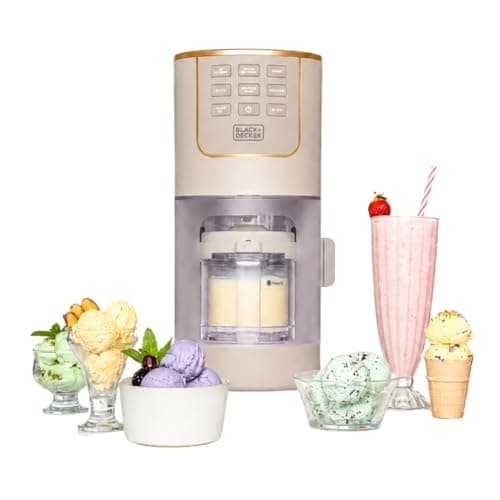 | 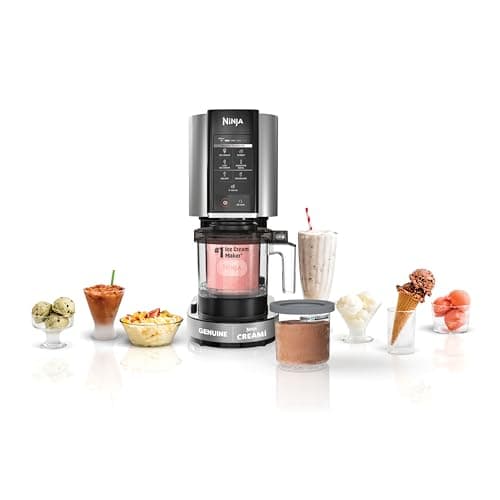 |
|---|---|---|
| Mechanism | Spin / blade, frozen base | Spin / blade, frozen base |
| Capacity | 1 pint, two containers included | 16 oz pint |
| Programs | 6 named, plus mix-in and Re-Spin | 7 one-touch |
| Published power | Not published | Ninja publishes 800 W on the NC501 |
| Spin time | ~3 min (TechEBlog) | One spin per pint |
| Footprint | About 12" x 7" (TechEBlog) | Taller and wider |
| Weight | About 19 lb (TechEBlog) | Lighter than the NC701's 22.2 lb |
| Re-spin cycle | Yes, a labeled button | Yes, Re-spin program |
| Independent testing | None we can cite | ATK Recommended with Reservations, June 2026 |
| Recipe ecosystem | New and small | The largest of any spin machine |
| Price |
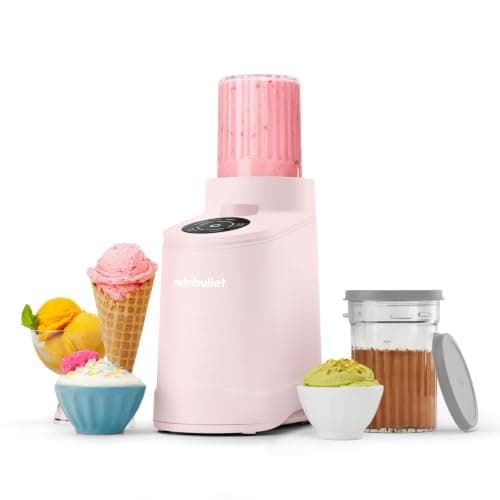
The honest read: the CREAMi wins on evidence and on its recipe library, which on a spin machine is a bigger practical advantage than it sounds, because the base has to be built to be shaved rather than churned and the CREAMi has thousands of tested ones. The Perfect Pint wins on the two containers in the box and on price, and it is the only one of the three from a hardware brand most buyers already recognize. The nutribullet Chill wins on footprint and on being the only one of the three whose maker publishes a full dimension and weight set — see the Chill review and CREAMi alternatives.
Who should buy it
Someone who wants a CREAMi-style machine without CREAMi money, and who values a mainstream brand's support over a spec sheet. Someone making lean, high-protein or dairy-free bases, where a spin machine is genuinely the right tool and the Re-Spin pass earns its place. And a household of one or two, where a pint is the right portion and two containers mean two flavors standing ready — see the one-person roundup.
Who should not
Anyone feeding a table. A pint is two servings, a second container means a second overnight freeze, and dessert for four is a two-day project. Anyone who wants one tub in the freezer rather than jars: a Cuisinart ICE-21P1 makes 1.5 quarts a batch and was America's Test Kitchen's best canister-style pick at a listed $70 in June 2026, which is roughly six times the volume for less money. And anyone who buys on measured evidence, because on this machine there is none to buy on.
Verdict
A sensible machine with a genuinely well-chosen feature and an unusually thin paper trail. The Re-Spin button is the right answer to the real failure mode of this whole machine type, two containers in the box is the correct call, and the program list covers what people actually make. If you want a pint machine and the CREAMi's price is the obstacle, this is a reasonable buy.
The reservations stand and we are not softening them: no lab we can cite has tested it, BLACK+DECKER publishes no wattage, and about 19 pounds is heavy for a pint. We would recommend it to a one or two-person household already sold on the frozen-pint workflow, and we would point anyone who wants measured evidence to the Ninja CREAMi, or anyone who wants volume to the main roundup. If the appeal is one machine covering several desserts, the 2-in-1 roundup sorts the real pairings from the long program lists. The two machines go row by row in CREAMi versus Perfect Pint.