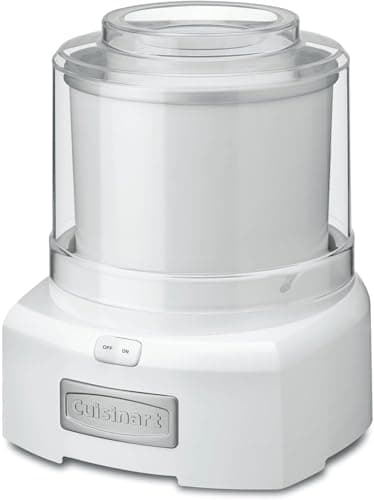
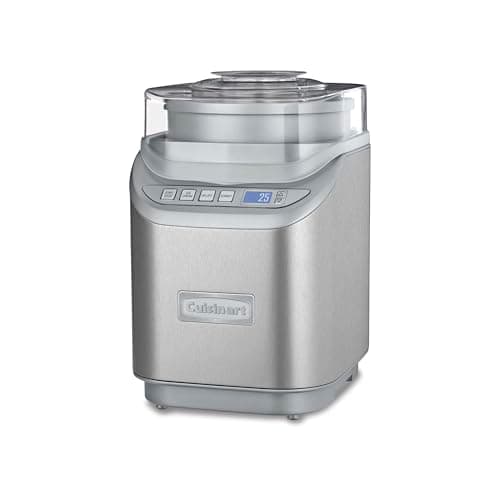
The Cuisinart ICE-21P1 is the best ice cream maker for the money, and the margin is not close. America's Test Kitchen listed it at $70 in its June 2026 equipment review and gave it the best canister-style award outright — a machine that costs a fifth of the compressor winner and makes ice cream the same reviewers rated above machines costing four times as much. Every other recommendation on this page is an answer to a more specific question than “which one gives me the most for my money.”
This is a different page from the under-$100 roundup, which is a hard price ceiling, and from the main roundup, which ranks on quality regardless of cost. Value is a ratio, so a $310 machine can be better value than a $70 one for the right household. Here is how that arithmetic actually works.
How we measure value, and the number nobody prints
Price per quart of rated capacity is the obvious metric and it is also the misleading one, because rated capacity is the point at which the churning mixture climbs out of the bowl rather than the amount you can usefully fill. Practical fill is roughly two thirds. Ice Cream Science is more specific still: it puts the optimal fill of the 2-quart Cuisinart ICE-70P1 at 900 milliliters and the 1.5-quart Lello 4080 at 700 milliliters, both far under the number on the box.
So the honest value question has three parts, and we rank on all three.
- What the machine costs, using published, dated prices only — ATK's June 2026 listings, because they tested the whole category on one day.
- What it costs to run. Every batch costs ingredients; some machines also cost ice, rock salt, freezer space or a second bowl.
- How many batches you will actually make. The cheapest machine in the world is poor value at nought batches a year, and this is where most ice cream maker purchases go wrong.
The number that settles most of these arguments
A cream-heavy homemade quart costs about $3.80 in ingredients at published August 2026 prices. Against the $4.15 weighted average advertised price USDA reported for a 14-to-16 ounce premium pint, a $70 canister machine pays for itself in roughly 16 batches and a $310 compressor machine in roughly 70. Full arithmetic, including the case where homemade costs you more, is in what homemade ice cream actually costs.
Why a $70 machine wins a value page
Because the expensive part of an ice cream maker is refrigeration, and a canister machine does not have any. It is a double-walled gel bowl you freeze solid and a small motor — 60 watts in the ICE-21P1 — turning a paddle. All the cold comes free from a freezer you already own and already run.
That is why the gap between $70 and $343 buys convenience rather than quality. ATK recommended the $343 Cuisinart ICE-100 in the same June 2026 round and still gave the best-canister award to the $70 machine. Dream Scoops measured the ICE-21 churning in roughly 15 to 20 minutes, which is quicker than its own more expensive ICE-70P1 sibling. You are not trading texture for price at the bottom of this category. You are trading planning.
The thing you give up is real and it is the reason this page is not simply over: the bowl needs 16 to 24 hours in the freezer, which makes ice cream a tomorrow decision, and it occupies a freezer shelf permanently if you want to stay ready. The mechanism behind that trade is in compressor versus freezer bowl.
Cheapest per quart is a different machine entirely
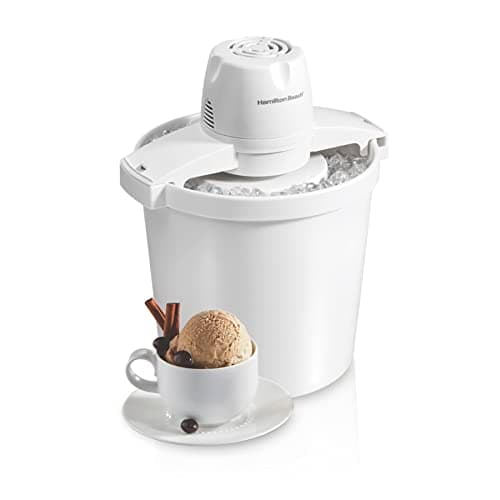
If the metric is purely dollars per quart of capacity, the bucket machines win and they win easily. The Hamilton Beach 68330N makes 4 quarts in a single batch for less than most 1.5-quart machines cost, which is more ice cream in one go than two compressor machines combined. The 80-watt motor stops itself when the mixture stiffens, there is no bowl to pre-freeze and no freezer shelf to surrender.
The catch is that bucket machines are the only type on this site with a per-batch consumable bill. You buy ice and rock salt every single time, the salt water has to be drained, and the whole operation wants a sink or a yard rather than a kitchen counter. Price it as the machine plus a bag of ice and a box of salt per batch and the arithmetic still works in its favor for a crowd — and falls apart entirely for a weeknight pint. How much salt, and why the ratio matters more than the brand, is in how much salt an ice cream maker needs.
The best value of all is the machine you already own half of
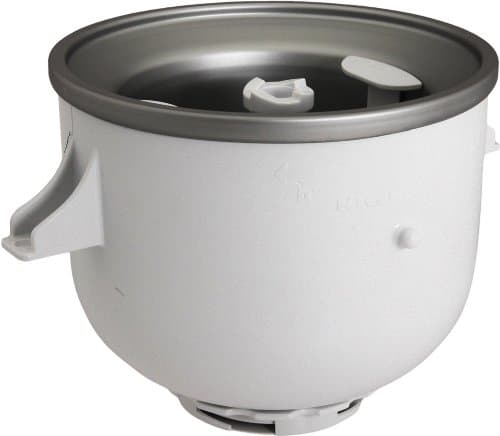
If there is a KitchenAid stand mixer on your counter, the KICA0WH attachment is the cheapest route to 2 quarts on this entire site, and it is cheap for a structural reason: you are buying a bowl and a dasher, not a motor. The mixer's motor is far stronger than anything inside a standalone canister machine, and there is no second appliance to store or plug in.
Two honest caveats. KitchenAid specifies at least 24 hours of pre-freeze, longer than most canister machines, and the bowl is large enough to claim a full freezer shelf. And it fits every current KitchenAid stand mixer except the 3.5-quart Artisan Mini per the manufacturer, with some tilt-head models needing the adapter ring. Buying the mixer in order to get the attachment is the most expensive 2 quarts here by a distance. The full comparison is in attachment versus standalone machine.
Value does not stop existing above $300
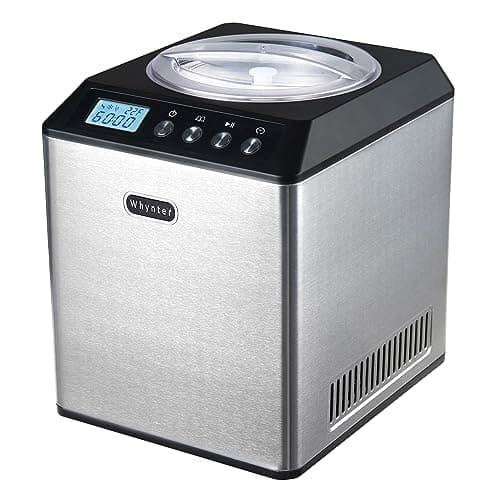
The Whynter ICM-201SB is the one expensive machine on this page that earns its place on value rather than in spite of it. ATK named it the best self-refrigerating machine in June 2026 and listed it at $310 for 2.1 quarts with no pre-freeze — the largest no-wait capacity of any machine they rated, in a smaller counter footprint than the shallower-but-deeper Cuisinart ICE-100, with a removable stainless bowl rather than a fixed one.
Set against the ICE-100 at $343 for 1.5 quarts, the Whynter is more capacity for less money. Set against the $600 Breville Smart Scoop, it is less than half the price and its output is far less contested — Dream Scoops advises against the Breville, reporting that it froze considerably slower than any other machine they tested and produced coarser, wetter, icier ice cream. Twelve hardness settings is a feature. A slow freeze is a defect.
Paying for texture instead of convenience
The Cuisinart ICE-70P1 is the value pick for someone who wants to get better at this rather than faster. It stays on the canister budget and adds the two things a one-switch machine cannot give you: an LCD countdown timer with auto shut-off, so you can repeat the batch that worked instead of guessing, and three texture programs that treat gelato and sorbet as real settings. Ice Cream Science rates its output the best of any canister machine it reviews — smooth and creamy with very few coarse bits.
What you pay for that, in a currency this page cares about, is time: Ice Cream Science measured it at 28 minutes 30 seconds, notably slower than the cheaper ICE-21, and its optimal fill is about 900 milliliters against a 2-quart rating. On ice cream that trade is fine. On a fat-free sorbet it is not, which is why the sorbet roundup ranks it differently.
The worst value here, and why we still recommend it
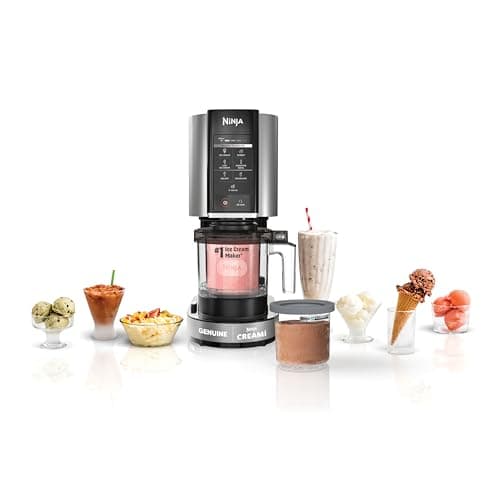
The Ninja CREAMi NC301 is poor value on every metric this page uses. ATK listed it at $207 in June 2026 and placed it in Recommended with Reservations. It produces 16 ounces per spin — a quarter of what a $70 canister machine makes — the pint has to freeze solid overnight anyway, so it saves no planning, and at 18.39 inches tall it will not fit under a standard wall cabinet.
It is on this page because value is not only arithmetic. The CREAMi is the only machine here that handles high-protein and low-sugar bases, which stall a churning paddle outright, and a capability no cheaper machine has at any price is not bad value — it is the only option. If that is why you are shopping, read the protein ice cream roundup instead, where it wins. If it is not, buy the canister machine.
Three false economies to avoid
A single-serving machine as a cheap way in. A DASH My Pint takes one cup of base and returns about 1.6 cups. Two of them cost more than one ICE-21P1 that makes eight times as much. It is the right machine for one person who eats alone, and the wrong one for a household trying to spend less.
Buying capacity you will freeze and forget. Homemade ice cream has no stabilisers, so it is best within two or three days and noticeably worse after a week. A 6-quart batch is value only if six quarts get eaten; storing homemade ice cream covers what actually happens to the rest.
Paying for programs instead of refrigeration. A machine advertising sixteen functions is advertising marketing. The thing that decides your ice cream is how fast the mixture freezes while it is agitated, and no menu changes that. The ICE-21P1 has exactly one switch.
So what should you buy
- Most people: the Cuisinart ICE-21P1, plus a spare freezer bowl. The spare bowl is the single best-value accessory in the category — it buys you two flavors in a day, which no bigger machine can do at any price.
- Own a KitchenAid mixer: the KICA0WH attachment. Cheaper than any standalone 2-quart machine and nothing extra to store.
- Feeding a crowd a few times a year: the Hamilton Beach 68330N. Cheapest capacity on the site if you are willing to buy ice.
- Will not plan 24 hours ahead: the Whynter ICM-201SB. Expensive, and still the best value among machines that need no pre-freeze, because the alternative is a cheap machine you never use.
- Protein or low-sugar bases: the Ninja CREAMi. Bad value, only option.
If you are not yet sure which of those describes you, how to choose an ice cream maker narrows it in four questions, and what size ice cream maker you need settles the capacity half of the decision before you look at a single price.