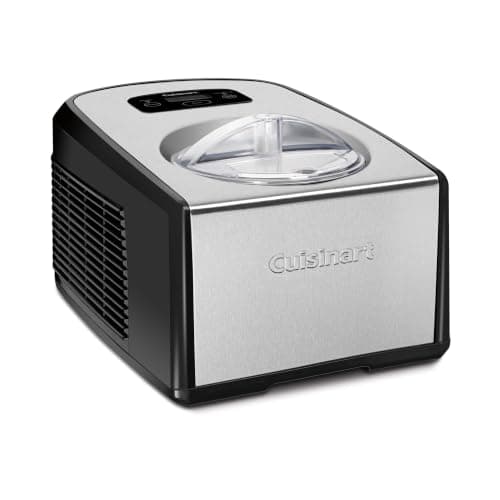
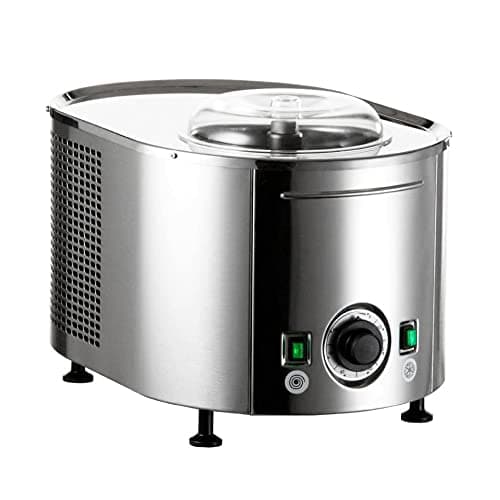
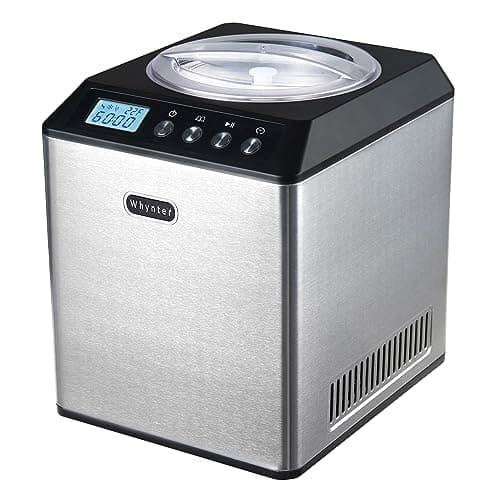
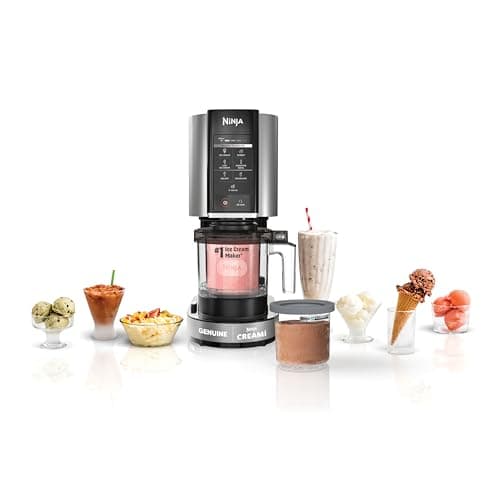
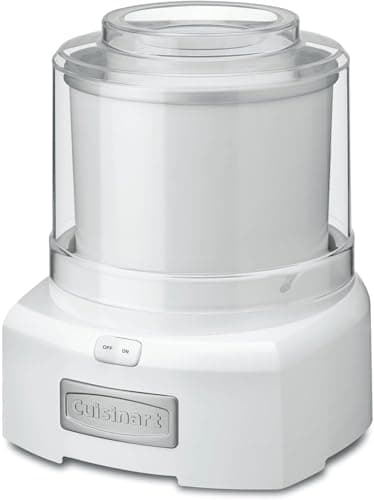
If you are buying a machine mainly for sorbet, buy a compressor machine — the Cuisinart ICE-100 if you want it to be affordable, the Lello 4080 if you want it to be the best. That is a different recommendation from our main roundup, where a $70 freezer-bowl machine wins outright, and the reason is worth two minutes of your time before you spend anything.
Sorbet is a different physics problem
Ice cream is roughly 10 to 16 percent butterfat, and that fat does an enormous amount of forgiving work. It coats ice crystals, it carries flavor, it keeps the mixture smooth even when the freeze was slower than ideal. A sorbet has none of it. Strip the dairy out and you are left with fruit puree, water and sugar, which means every ice crystal the machine grows is a crystal you taste directly.
So what separates a silky sorbet from a grainy one is almost entirely crystal size, and crystal size is set by how fast the mixture freezes while it is being agitated. Foodal's write-up of sorbet technique puts the mechanism plainly: churning works by “decreasing the size of the ice crystals that form as the water in the puree freezes.” The faster the freeze and the more constant the agitation, the more crystals you get and the smaller each one is. It is the same principle behind icy homemade ice cream, except sorbet is that problem with no safety net.
That one fact reorders the category. Capacity, program count, mix-in dispensers, hardness sensing — none of them move the needle on sorbet. Freeze speed does.
Criterion one: how fast it actually freezes
We rank on measured freeze time wherever a published measurement exists, and Ice Cream Science's machine reviews are the most useful numbers in the category because they time the same task across different machines. The spread is enormous. They measured the Lello 4080 Musso Lussino at 17 minutes 30 seconds, the fastest freeze they report, and the freezer-bowl Cuisinart ICE-70P1 at 28 minutes 30 seconds. Eleven extra minutes is a long time to be growing crystals in a mixture that is mostly water.
There is a structural difference underneath those numbers. A compressor machine refrigerates continuously, so it pulls heat out of the mixture at a steady rate from the first minute to the last. A freezer-bowl machine starts with a fixed amount of cold stored in a gel wall and spends it. By the end of a churn the bowl is warmer than when it started and the freeze is slowing down exactly when the mixture most needs it. With a fatty ice cream base you can get away with that. With sorbet you taste it. The longer version of that argument is in compressor versus freezer bowl.
Why the under-fill rule matters twice as much here
Ice Cream Science puts the optimal fill of the 2-quart ICE-70P1 at 900 milliliters and the 1.5-quart Lello 4080 at 700 milliliters. Less mixture against the same cold surface means a faster freeze, which on a sorbet is the difference between smooth and sandy. Fill any machine on this page to its rated capacity for sorbet and you have chosen volume over texture. For the arithmetic behind those numbers, see how long to churn.
Criterion two: how little air it puts in
Air in a frozen dessert is called overrun, and sorbet wants far less of it than ice cream does. A sorbet whipped full of air goes pale, tastes thin, loses the sharp fruit edge that is the entire point, and collapses into foam as it warms. A dense sorbet tastes more intensely of the fruit for the simple reason that there is more fruit per spoonful.
This is where the Cuisinart ICE-100 earns first place on a page about a dessert it has no dedicated program for. It ships with two paddles, one for ice cream and one for gelato, and the gelato paddle is shaped to move the mixture rather than aerate it. Gelato and sorbet want the same thing from a paddle, so the low-air paddle is the right tool for both. Dream Scoops singles out that ability to vary air content as an advantage of the machine, and it is the only machine we cover that gives you a mechanical choice about it. The full explanation is in overrun explained.
The spin machines arrive at the same place from the opposite direction. A Ninja CREAMi does not churn a liquid at all: it shaves a block that is already frozen solid, which incorporates relatively little air by default. That is structurally sorbet-friendly, and sorbet is one of the seven one-touch programs on the NC301.
Criterion three: the batch you will actually serve
Sorbet is the course that follows a heavy meal, which in practice means more people eating smaller portions than with ice cream. Two useful numbers: the Whynter ICM-201SB holds 2.1 quarts with no pre-freeze, the largest no-wait capacity among the machines America's Test Kitchen rated in June 2026, and a CREAMi pint is 16 ounces, which is one or two servings. If you are making lemon sorbet for eight people after dinner, those two machines sit at opposite ends of the same decision.
Capacity ranks third here rather than first because you can solve it with planning on any machine, whereas you cannot plan your way out of a slow freeze. It is still the criterion most likely to make you regret a purchase, so be honest about how many bowls are on your table.
What we deliberately ignored
Three things that sell machines and do nothing for sorbet. Mix-in dispensers, because a sorbet with cookie pieces in it is not a sorbet. Hardness sensing, because a fat-free mixture firms up predictably and you can feel it through the paddle. And program count: a machine advertising sixteen functions is advertising marketing, not refrigeration. The Cuisinart ICE-21P1 has exactly one switch and makes excellent sorbet.
The picks, and what is wrong with each one
Cuisinart ICE-100 — first place. A compressor at the only sane price in the category, plus the low-air paddle. America's Test Kitchen recommended it in June 2026 and Dream Scoops calls it the best value alternative to a several-hundred-dollar Italian machine. The honest problems: it costs several times a canister machine, it weighs 28 pounds, it is 16.73 inches deep, and it still makes only 1.5 quarts. It lives on your counter or it does not get used. Detail in the full ICE-100 review.
Lello 4080 Musso Lussino — best texture, worst value. The fastest measured freeze of anything here, and output Ice Cream Science describes as extremely smooth, dense and creamy. For sorbet specifically it is the closest a home machine gets to a pasticceria. The problems are blunt: 38 pounds, a fixed bowl you clean in place, an optimal fill of 700 milliliters against a 1.5-quart rating, and a price Dream Scoops flags as its main drawback. It is furniture, not a small appliance.
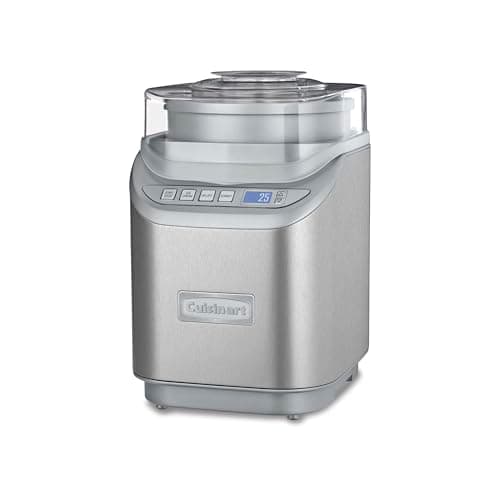
Cuisinart ICE-70P1 — the budget pick with a real sorbet setting. Three texture programs, one of them sorbet, plus an LCD countdown timer that lets you repeat the batch that worked instead of guessing. Ice Cream Science rates its output the best of any canister machine they review. The problem is the one this whole page is about: at a measured 28 minutes 30 seconds it is the slowest machine here, and a slow freeze is a sorbet's worst enemy. Under-fill it to about 900 milliliters and it is genuinely good. See the ICE-70P1 review.
Whynter ICM-201SB — for a crowd. ATK's best self-refrigerating pick, 2.1 quarts, no pre-freeze, removable stainless bowl. If sorbet is something you serve to guests rather than eat alone, this is the practical answer. The problems: no low-air paddle option, 24.25 pounds, and Dream Scoops rated a different, smaller Whynter poorly on build quality, which is worth knowing even though it is not this model.
Ninja CREAMi NC301 — for fruit you already have. Blend fruit, freeze the pint, press sorbet. No cooking, no syrup to cool, no bowl to pre-freeze, and whole-fruit purees that would stall a churning paddle go through it fine. The problems are the family's usual ones: 16 ounces per spin, the pint has to freeze solid first, and ATK placed it in Recommended with Reservations in June 2026. Four people means four pints frozen the night before. Start at the CREAMi review if this is the direction you lean.
Cuisinart ICE-21P1 — the one most people should buy. No sorbet program, no timer, nothing to learn, and ATK's best canister-style award at $70 in its June 2026 review. It churns in roughly 15 to 20 minutes, quicker than its more expensive ICE-70P1 sibling, and on a sorbet that matters more than any feature either machine has. The problems: a 16 to 24 hour pre-freeze, one batch per bowl, and 79 to 82 decibels while it runs per Dream Scoops.
The recipe does more work than the machine
Sorbet is the one place on this site where we will tell you the base matters more than the hardware, because sugar concentration is doing the job that fat does in ice cream. Ice Cream Nation puts a fruit sorbet mixture at about 25 to 35 percent overall sugar, roughly 30 to 31 degrees Brix; Foodal gives a similar 20 to 30 percent window. Those numbers are not about sweetness. Sugar depresses the freezing point, so it decides how much of your water is frozen solid at serving temperature.
Get it wrong in either direction and no machine saves you. Ice Cream Nation is exact about both failures: too sweet and “the level of sugar will prevent the sorbet from freezing properly”; too little and “the sorbet will freeze too hard” and the flavor tastes watered down. Foodal adds two useful levers — swapping up to half a cup of the sugar for glucose or corn syrup to improve texture, and no more than a tablespoon of liquor per cup to lower the freezing point further. Our sorbet recipe is built to sit inside that window, and storing homemade ice cream covers the part everyone gets wrong afterwards, because a correctly made sorbet can still be ruined by three weeks in a frost-free freezer.
Sorbet, sherbet and dairy-free are three different pages
Worth separating, because the machine answer changes. Sorbet is fruit, water and sugar with no dairy at all, which is this page. Sherbet adds a small amount of milk or cream, which puts back some of the fat's forgiveness. And a dairy-free ice cream made with coconut or oat milk behaves far more like ice cream than like sorbet, because plant fat does similar structural work. If what you want is a vegan scoop rather than a fruit ice, read that page instead — the ranking there is different and so is the reasoning.
Who should not buy a machine for this
If sorbet is a twice-a-summer thing, do not buy anything. A shallow metal tray, a fork and a freezer make a granita-textured fruit ice that is genuinely good, and ice cream without a machine covers the method. It will not be smooth the way a churned sorbet is smooth, and that is the honest trade: a coarse texture for free, or a fine texture for what a machine costs.
And if you are buying one machine for a household that eats ice cream and occasionally wants sorbet, buy for the ice cream. Every machine on this page makes sorbet, the cheapest one included. Nothing here is a sorbet specialist the way a gelato machine can be, because sorbet does not ask for a special paddle or a special program. It asks for cold, fast.