Overrun is the amount of air churned into ice cream, expressed as the percentage increase in volume. A quart of base that comes out as a quart and a half has 50 percent overrun. It is the most useful single concept in frozen desserts and almost nobody outside the industry knows the word.
Why there is air in ice cream at all
Not to cheat you, although it does that too. Air does real work.
It makes ice cream scoopable. A frozen block of cream, milk and sugar with no air in it is close to unyieldable at freezer temperature. Air makes the structure compressible, which is what lets a scoop go in.
It changes how cold it feels. Air conducts heat poorly, so an aerated frozen dessert feels less shockingly cold on the tongue than a dense one at the same temperature.
It lightens the texture. Whether that is desirable is a preference, and it is the whole difference between American-style ice cream and gelato.
The numbers, roughly
Cheap commercial ice cream: up to about 100 percent overrun, meaning half the container is air. This is why a budget half-gallon is so light to carry and so cheap per ounce.
Premium commercial ice cream: considerably lower. Denser, heavier tubs for the same volume, which is part of what you are paying for.
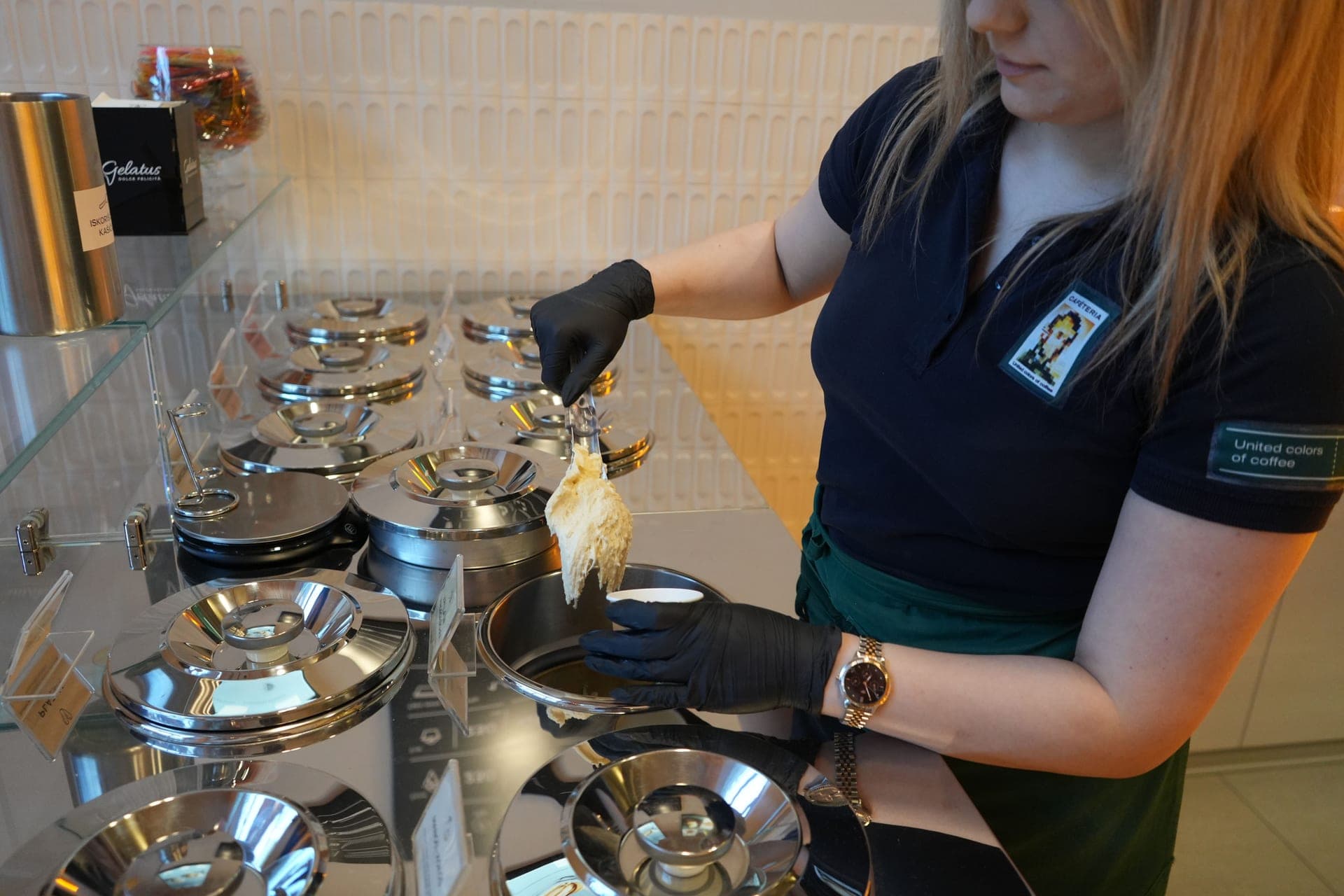
Gelato: low. Density and intense flavor are the defining characteristics.
Homemade in a domestic machine: lower than commercial, because a small paddle in a small bowl for twenty minutes cannot whip in what an industrial continuous freezer does.
Why this explains the cost gap
Air is free. If half the container is air, the manufacturer is selling you half as much actual food per unit of volume, which is exactly why bulk ice cream can be cheaper per ounce than anything you can make at home with real cream.
So when you compare a homemade quart against a supermarket tub, you are not comparing like with like — yours has more food in it. The arithmetic is in what homemade ice cream actually costs.
There is an easy test: weigh them. A dense premium pint and a cheap pint of the same volume can differ substantially in weight, and the difference is air.
Why your homemade ice cream is harder from the freezer
This is the most common complaint about homemade ice cream and overrun is most of the answer. Less air means a denser, more solid structure, and a dense structure resists a scoop.
Two fixes, neither of which requires a different machine:
Let it sit out for five to ten minutes. Solves it in practice, every time.
Keep the sugar as your recipe says. Sugar lowers the freezing point, which matters more in a low-overrun ice cream than a high-overrun one. See why homemade ice cream is rock hard.
How to control overrun in your own batches
Churn time. The biggest lever you have. Air goes in continuously while the paddle turns, so a longer churn means more air. Stop at soft-serve consistency and you keep overrun moderate; run it well past that and you get a foamier result. See how long to churn.
Fill level. More base in the bowl leaves less room for the paddle to whip air in. A fuller bowl naturally produces lower overrun — though never fill past two thirds, or it climbs out.
The paddle. The Cuisinart ICE-100 ships with two, one shaped to aerate and one shaped to move the mixture without whipping it. That is the only mechanical overrun control in the consumer category, and it is why that machine tops the gelato roundup.
Freeze speed. A faster freeze means less time for air to be incorporated. Ice Cream Science measured the Lello 4080 at 17 minutes 30 seconds and describe its output as extremely dense — those two facts are connected.
Fat content. Higher fat holds air more stably, which is why a rich custard base whips up more than a lean one.
Gelato is a low-overrun ice cream
That is genuinely most of the definition. Gelato also tends to use more milk and less cream, and is served a few degrees warmer, but the air content is the characteristic difference. It is why gelato tastes more intensely of its flavor: there is more of it per spoonful.
Which means you can make something recognisably gelato in a $70 canister machine by using a milk-heavier base and stopping the churn earlier. No special equipment required, though a dedicated paddle does it better.
How much overrun should you want?
Less than commercial, more than none. A completely dense frozen custard is hard to scoop and, oddly, tastes heavy. A moderate amount of air is what makes ice cream pleasant rather than merely rich.
In practice a domestic machine churned to soft-serve consistency lands in a good place without you doing anything. The reason to understand overrun is not to hit a target — it is so that when a batch comes out foamy or brick-like, you know which lever to pull.