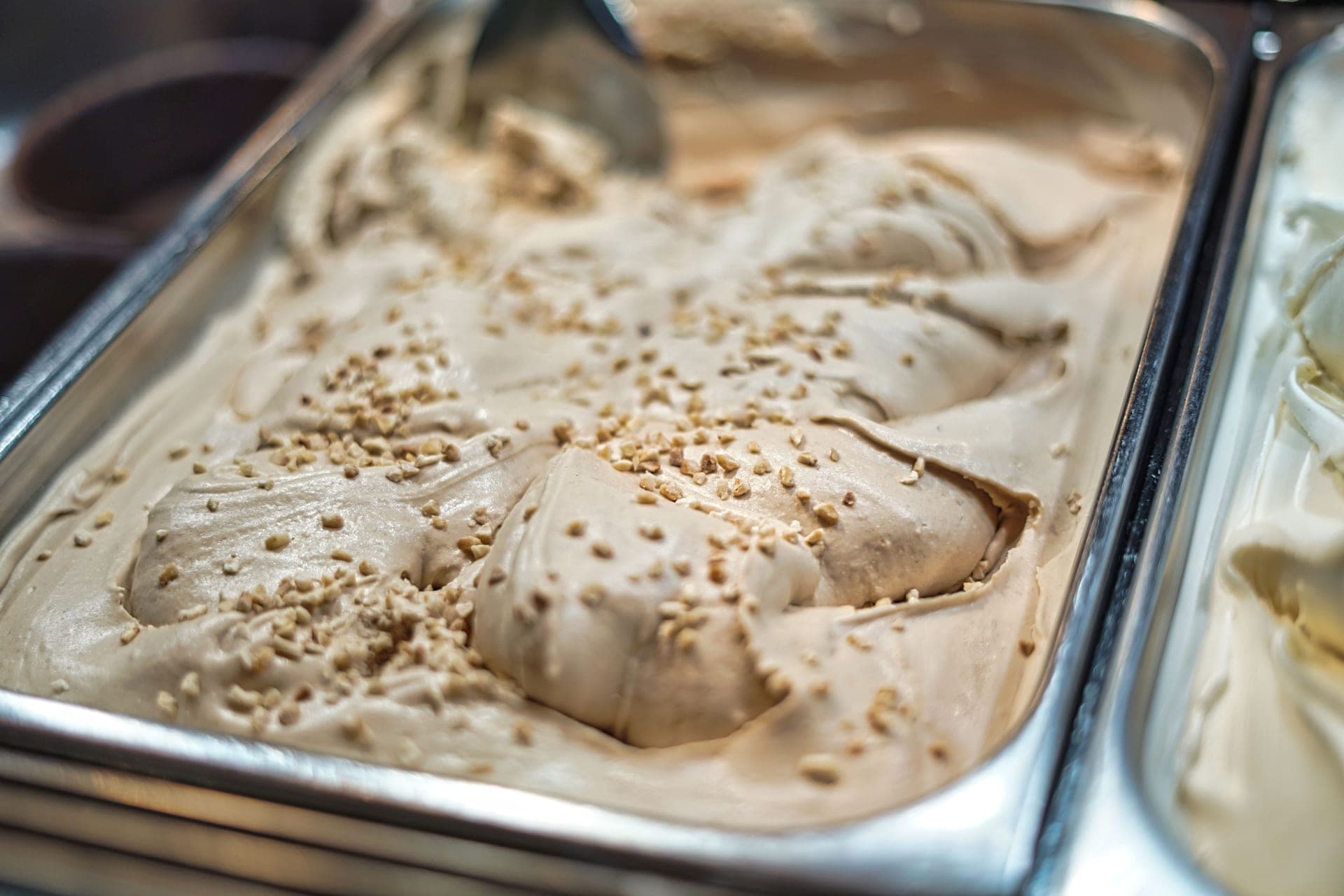
For a standard 1.5-quart batch you need heavy cream, whole milk, granulated sugar, a pinch of salt and vanilla — roughly two cups of cream to one cup of milk and three quarters of a cup of sugar. Add egg yolks if you want a custard base. That is the whole shopping list, and nothing on it is exotic or expensive.
What is worth five minutes is knowing what each one is physically for, because every texture complaint about homemade ice cream traces back to one of these five.
The five ingredients and their jobs
- Heavy cream — fat, and therefore smoothness. Fat globules get between growing ice crystals and physically stop them joining into bigger ones. Fat is also what carries flavor and what makes ice cream feel rich rather than merely cold. This is the single most important ingredient on the list.
- Whole milk — body without greasiness. Milk solids, chiefly protein and lactose, bind water so there is less free water available to freeze into crystals. All cream and no milk gives a heavy, slightly waxy result.
- Sugar — antifreeze, not just sweetness. Sugar lowers the freezing point of the mixture, which is the reason ice cream stays scoopable at freezer temperature instead of setting into a block. Cut the sugar and you get something harder, not just less sweet.
- Salt — flavor only. A quarter teaspoon per batch. It does nothing to the freezing, but it makes dairy and vanilla taste like themselves. This is a completely separate thing from the rock salt a bucket machine packs around its canister.
- Vanilla — or whatever you are making. Extract added to the cold base; a pod split and steeped in warmed milk gives more.
The ratio to start from
2 cups heavy cream : 1 cup whole milk : 3/4 cup sugar : 1/4 tsp salt : 1 tbsp vanilla. That is roughly four cups of liquid, which fits a 1.5-quart machine with the room it needs to expand. Do not scale it up to fill the bowl to the brim — published optimal-fill figures sit well below rated capacity, with Ice Cream Science putting the Cuisinart ICE-70 at around 900 ml against a 2-quart rating.
Which cream to buy
In the US, heavy cream and heavy whipping cream are the same thing for this purpose, at 36% fat or more, and either is the right choice. “Whipping cream” without the “heavy” is around 30% and will work with slightly less richness.
Half-and-half is not a substitute for cream. At roughly 10 to 12% fat it does not supply enough fat to block ice crystal growth, and a base made with it comes out icy however well you churn — which is the first thing to check in why homemade ice cream is icy. You can use it to replace the milk portion, not the cream portion. Avoid cream sold as ultra-pasteurized if you have a choice; it whips and tastes slightly less well, though it will work.
Eggs, and whether you need them
Egg yolks make a custard base, also called French style. The lecithin in the yolks is an emulsifier, holding fat and water together in a stable mixture, which gives a denser, silkier result that resists ice crystals better and keeps longer in the freezer. The cost is that you have to cook it: yolks whisked with sugar, tempered with hot milk, then cooked gently to a custard and strained.
A Philadelphia base uses no eggs at all — cream, milk, sugar, flavor, stirred cold and churned. It takes five minutes to make, tastes cleaner and fresher, and is the right place to start. The trade-offs are laid out properly in custard versus Philadelphia base, and our no-fail vanilla is the no-cook version.
The two ingredients worth adding next
Corn syrup or glucose, replacing a little of the sugar. These are larger-moleculed sugars that depress the freezing point effectively while contributing less sweetness, so they make ice cream softer and smoother without making it cloying. Swapping two tablespoons of the granulated sugar for corn syrup is the cheapest texture improvement available.
Nonfat dry milk powder, a tablespoon or two. This adds milk solids — more protein and lactose binding more water — without adding liquid that has to be frozen. It is what commercial manufacturers do, and it noticeably reduces iciness.
What you do not need is a bag of commercial stabilizers. Homemade ice cream has none, which is why it is best in the first two or three days, and that is a reasonable trade rather than a problem to engineer away — see storing homemade ice cream.
Alcohol, and the limit on it
A tablespoon or two of vodka, bourbon or a liqueur in a 1.5-quart batch keeps the finished ice cream softer and easier to scoop, because alcohol depresses the freezing point strongly. Go much beyond that and the mixture will not set at all in the machine. Boozy ice cream that stays liquid is nearly always too much alcohol rather than a machine fault — worth ruling out before working through ice cream maker not freezing.
If you are not making dairy ice cream
Sorbet needs only fruit puree, sugar and water, and the sugar proportion is doing all the work — ratios in sorbet in an ice cream maker. Frozen yogurt swaps most of the dairy for strained yogurt, which is stiffer and needs a stronger motor. Dairy-free works best with full-fat coconut milk, because the fat content is closest to cream; the machines that handle it are in best ice cream makers for dairy-free.
And for the whole sequence once the shopping is done, how to use an ice cream maker takes it from cold base to hardened tub.