“Grainy” gets used for four genuinely different textures, with four different causes. Work out which one you have before changing anything, because the fixes contradict each other.
Identify it first
Crunchy or crystalline — you can feel distinct ice crystals. That is iciness, not graininess, and it has its own page: why homemade ice cream is icy.
Sandy or gritty, sweet — fine particles that dissolve on your tongue. Undissolved sugar. Cause 1.
Greasy or buttery, with small hard flecks — the fat has separated. Cause 2.
Powdery or crumbly, falling apart rather than scooping — almost always a spin machine. Cause 4.
1. Undissolved sugar
The most common cause of a genuinely gritty, sandy texture, and the easiest to fix.
Granulated sugar takes real effort to dissolve in cold cream. Stir it in casually, churn the batch, and you get a sandy mouthfeel plus a sweet layer at the bottom of the container.
Fix: whisk the sugar into the milk first, not the cream, and keep going for two or three minutes until you cannot feel grains on the bottom of the bowl. For a cooked base, warm the dairy with the sugar until it is fully clear.
The same applies to cocoa powder, which needs to be bloomed in warm liquid rather than whisked into cold cream — see the chocolate ice cream recipe.
2. Over-churned, so the fat separated
Churn too long and you are effectively making butter. Fat globules collide, stick together and form small hard flecks, and the texture turns greasy rather than creamy.
This is the one failure that genuinely is caused by using the machine too much.
Fix: stop when the mixture looks like thick soft serve and the paddle leaves a ridge that holds for a second. Churning longer never firms ice cream up — only the freezer does that. See how long to churn.
Higher-fat bases are more susceptible, which is worth knowing if you increased the cream.
3. A curdled custard base
If you cooked a custard and it got too hot, the egg proteins set into tiny lumps. Those lumps survive churning and freezing, and they read as a slightly chalky, grainy texture.
Fix, for next time: cook to roughly 170 to 175 F over medium-low heat, stirring constantly, and never let it boil. Temper properly by adding hot dairy to the yolks slowly.
Fix, for the batch in front of you: strain it. Pour the custard through a fine sieve into the reserved cold cream. Doing this every time, as a habit rather than a rescue, makes a curdled base almost impossible — the method is in custard versus Philadelphia.
4. A spin machine on a lean base
If it came out of a Ninja CREAMi or similar and looks like packed snow, this is your cause — and it is not a fault.
A low-fat, low-sugar base freezes into a hard, heavily crystalline block, and a blade driven through a hard crystalline block produces powder. The machine did exactly what it should; the block was the problem.
Fix now: add one to two tablespoons of milk down the side of the pint and run the re-spin. This is the intended workflow.
Fix next time: a tablespoon of cream cheese, a tablespoon of real sugar, and whole milk rather than skim. Full detail in Creami downsides and the protein recipe.
5. Add-ins that froze into hard particles
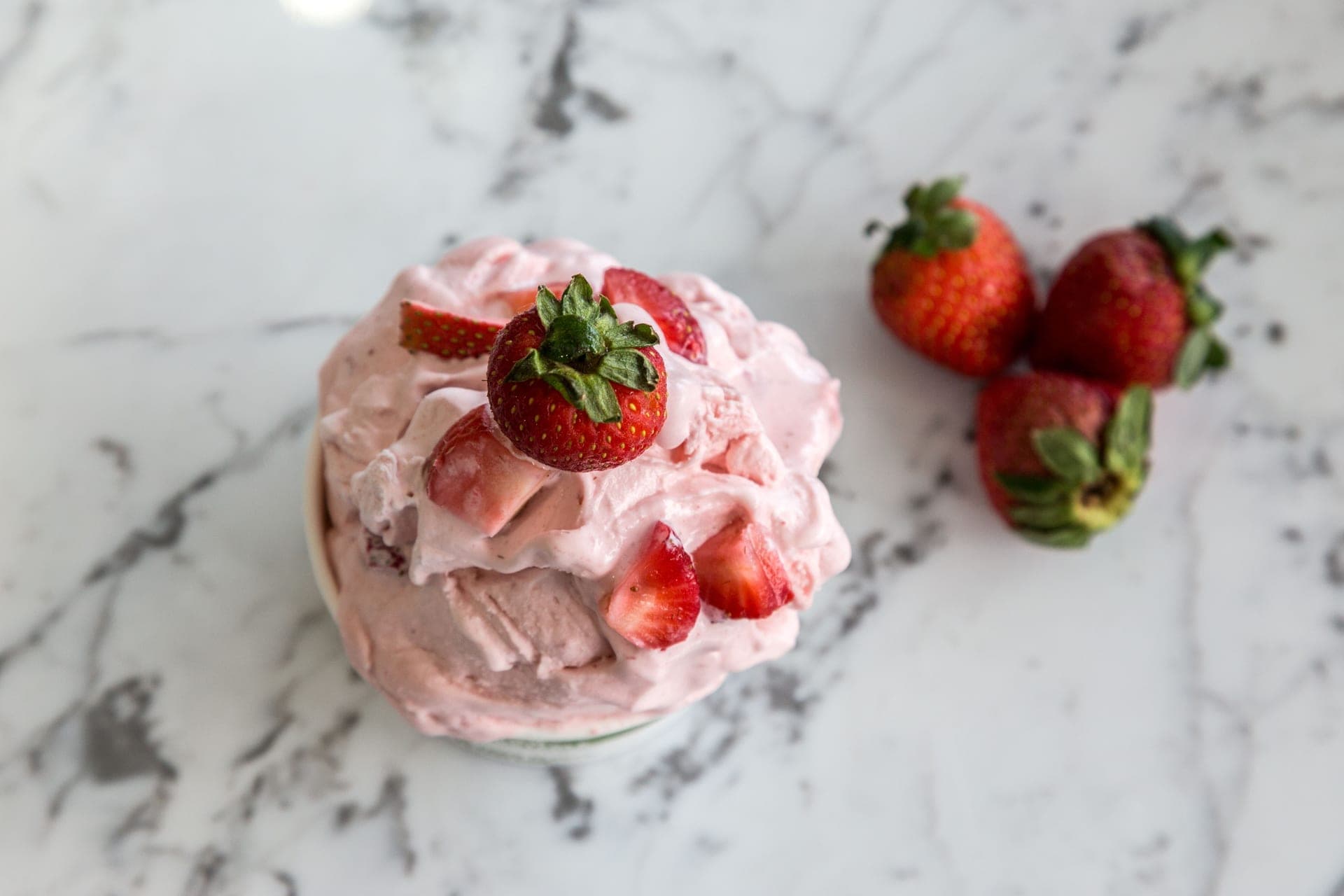
Sometimes the ice cream is fine and the things in it are not. Fruit pieces, chocolate chunks and nuts all freeze harder than the ice cream around them, because they contain little fat and, in the case of fruit, a lot of water.
Fix: chop mix-ins small — a quarter inch is pleasant, a whole halved strawberry is a frozen rock. Keep macerated fruit in its syrup rather than rinsing it, so it carries sugar into the freezer. And add inclusions in the last minute of churning or by hand afterwards, never at the start.
The checklist
- Sugar fully dissolved in the milk before the cream went in?
- Churn stopped at soft-serve consistency rather than run on?
- Custard cooked below boiling and strained through a sieve?
- Spin-machine base containing some real fat and sugar, and re-spun with a splash of milk?
- Mix-ins chopped small and added at the end?
If it is not grainy but crystalline, go to why homemade ice cream is icy. If it is smooth but too solid to scoop, go to why homemade ice cream is rock hard.