Buy the ICM-201SB unless you will genuinely culture your own yogurt. It holds the same 2.1 quarts, draws the same 180 watts, weighs the same 24.25 pounds, has the same removable stainless bowl, is 4.25 inches narrower, and it is the one America's Test Kitchen actually rated — their best self-refrigerating pick at a listed $310 in June 2026. Buy the ICM-220CGY if the yogurt incubator is the point, because nothing else on this site has one, and it is also rated 5 dBA quieter.
This is the narrowest comparison on the site. Both machines are the same compressor platform from the same manufacturer: pour the base in, nothing frozen in advance, batches back to back, lift the bowl out to wash it. Neither has a gelato paddle. Neither has been tested by Ice Cream Science. The decision is one feature and one dimension.
Side by side
| Spec | 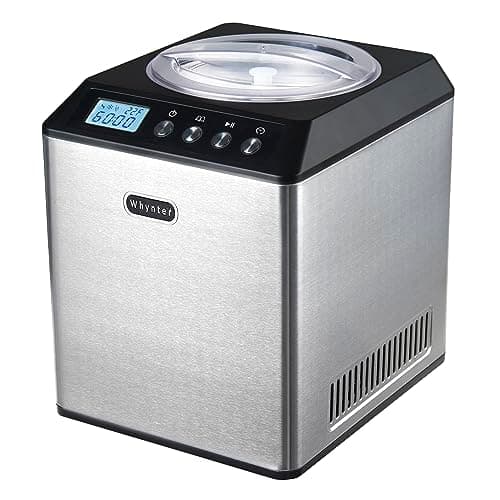 | 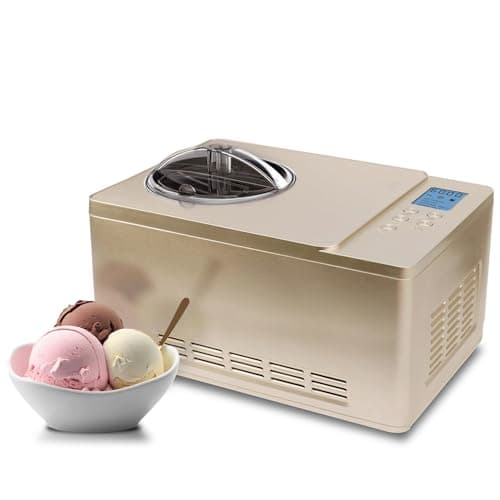 |
|---|---|---|
| Mechanism | Compressor, no pre-freeze | Compressor, no pre-freeze |
| Capacity | 2.1 qt | 2.1 qt |
| Power | 180 W | 180 W (max 1.2 A, 110/120 V) |
| Rated noise | 60 dBA or less | 55 dBA |
| Cooling range | -0.4 F to -31 F | -0.4 F to -31 F |
| Yogurt incubator | No | Yes, 104-110 F |
| Shape | Upright | Horizontal |
| Dimensions | 12.5" W x 10.75" D x 14.25" H | 16.75" W x 11.25" D x 10.25" H |
| Weight | 24.25 lb | 24.25 lb net |
| Bowl | Removable stainless steel | Removable stainless steel |
| Gelato paddle | No | No |
| Published warranty | Whynter standard | 1 year limited |
| ATK June 2026 | Best self-refrigerating, listed $310 | Not in the rated set |
| Independent texture verdict | ATK rated the machine | None we can cite |
| Price |
The incubator is the entire difference
Frozen yogurt has two stages and most machines only do the second. Culturing is the first: live bacteria held at body temperature for hours, feeding on lactose and producing the acid that makes yogurt taste like yogurt. Freezing is the second. The 220CGY holds the mixture at 104 to 110 F to culture it and then drops the same bowl to between -0.4 F and -31 F to churn it frozen. The 201SB can only do the freezing, which means starting from a tub someone else cultured.
Whether that is worth paying for is a question about your kitchen habits rather than about either machine. If you already make yogurt, or have wanted to and been put off by the warm-oven workarounds, the incubator replaces a separate appliance and you get to choose the milk, the fat level and the incubation length — which is where frozen yogurt flavor is actually decided. If you buy yogurt in tubs, you would be paying for a heating element you never switch on. The science is in frozen yogurt versus ice cream.
One honest limit on the feature: Whynter publishes no incubation time. The machine is the vessel, not a shortcut, so budget the several hours home yogurt normally takes.
The asymmetry that should bother you
America's Test Kitchen rated the ICM-201SB and named it their best self-refrigerating machine in June 2026. They did not include the ICM-220CGY. Same manufacturer, same platform, but only one of these two machines has an independent verdict attached to it, and we are not going to transfer that verdict across on the basis of a shared spec sheet. Dream Scoops also rated a different, smaller Whynter poorly on build quality. If you want to buy on evidence rather than specification, that points at the 201SB, and our methodology explains why we weight it that way.
Width against height: measure before you order
These two machines occupy counter space in opposite directions, and it is the second real difference. The 201SB is upright: 12.5 inches wide, 10.75 deep, 14.25 tall. The 220CGY is horizontal: 16.75 inches wide, 11.25 deep, 10.25 tall.
So the 220CGY is 4.25 inches wider and the 201SB is 4 inches taller. If your constraint is a wall cabinet above the counter, the low horizontal machine wins and the upright one may not fit under it at all. If your constraint is a narrow gap between a sink and a hob, the upright wins outright. At 16.75 inches the 220CGY is the widest compressor machine we cover. Neither is small: both are 24.25 pounds, which means whichever you buy lives on the counter rather than in a cupboard. The arithmetic for tight kitchens is in best machines for small spaces.
Five decibels, and why it is not nothing
Whynter rates the 220CGY at 55 dBA and the 201SB at 60 dBA or less. Compressor noise is the most common complaint about this entire machine type, and unlike a canister machine — where the racket lasts twenty minutes and then stops — a compressor hums for the whole 25 to 40 minute batch and does it every time. On the published figures the 220CGY is the quietest compressor on this site.
Read it carefully, though. Both numbers are manufacturer ratings, nobody we cite has measured either, and “60 dBA or less” is a ceiling rather than a measurement. Treat it as a tiebreaker, not a reason to buy. Our quietest ice cream makers roundup explains which decibel claims are worth comparing.
What neither of them does
Gelato, properly. Neither Whynter ships a second low-air paddle, and a gelato program is not a substitute for a blade shaped to fold in less air — the mechanism is in overrun explained. If gelato is the second dessert you care about rather than yogurt, the answer is the Cuisinart ICE-100, which ships both paddles and carries a three-year US warranty, at the cost of 0.6 quarts of capacity and 3.75 more inches of counter depth. That trade is worked through in ICE-100 versus ICM-201SB.
Neither includes a spare bowl either. Whynter lists bowls, blades and a scoop as accessories sold separately, so two flavors in one evening means washing up in between or buying a second bowl — the same calculation as do you need a second freezer bowl, minus the overnight freeze.
The verdict
- You will culture your own yogurt: ICM-220CGY. Nothing else here does it.
- You buy yogurt in tubs: ICM-201SB. Same ice cream, narrower, ATK-rated.
- A wall cabinet is your constraint: ICM-220CGY at 10.25 inches tall.
- A narrow counter gap is your constraint: ICM-201SB at 12.5 inches wide.
- The second dessert is gelato: neither — Cuisinart ICE-100, for the paddle.
Both get the full treatment in the ICM-201SB review and the ICM-220CGY review. If you have not settled on a compressor at all yet, start with compressor versus freezer bowl and the compressor roundup.