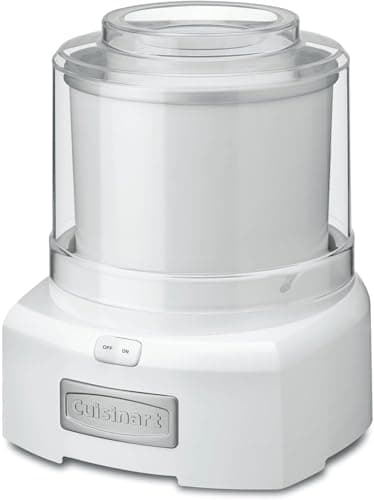
Buy the ICE-100 if the 16-to-24-hour pre-freeze is the thing that would stop you using the machine. Buy the ICE-70P1 if you will plan ahead, because it makes more ice cream, costs a fraction as much, and Ice Cream Science rates its texture the best of any canister machine it reviews. This is not a quality comparison. It is a comparison between buying time and buying control.
Side by side
| Spec | 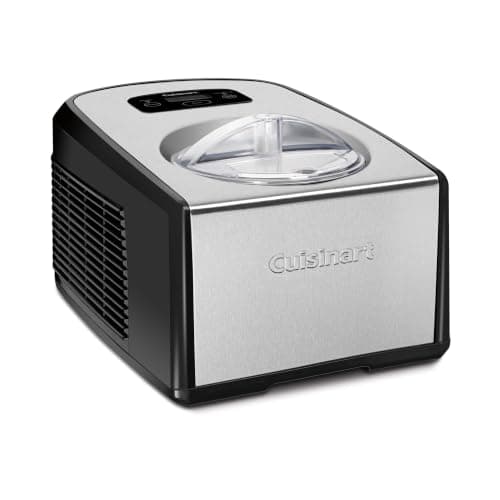 | 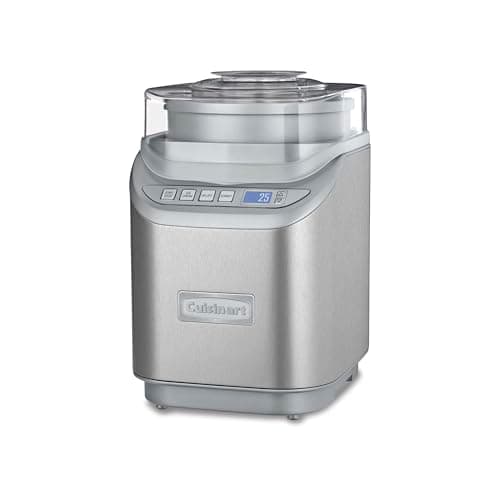 |
|---|---|---|
| Mechanism | Compressor, self-refrigerating | Freezer bowl, pre-freeze required |
| ATK June 2026 | Recommended, $343 | Not in ATK's rated set |
| Capacity | 1.5 qt | 2 qt (900 ml optimal fill) |
| Pre-freeze | None | 16-24 hours |
| Measured churn | Not published | 28 min 30 s (Ice Cream Science) |
| Back-to-back batches | Yes | No, the bowl must refreeze |
| Paddles | Two: ice cream and gelato | One |
| Controls | 60-min timer, 10-min Keep Cool | LCD timer, 3 texture programs |
| Power | 288 W | Small canister motor |
| Weight | 28 lb | Light enough to store in a cupboard |
| Depth on the counter | 16.73" | Compact |
| Warranty | 3 years (US) | Standard Cuisinart cover |
| Price |
The difference is refrigeration, and it costs everything
The ICE-100 contains a compressor: a working refrigeration unit that pulls heat out of the mixture continuously from the first minute to the last. The ICE-70P1 contains no refrigeration at all. It is a double-walled gel bowl that you freeze solid, and it spends that stored cold over the course of a churn, getting warmer as it goes.
That single fact produces every other difference between these machines. The compressor is why the ICE-100 needs no planning, runs batches back to back, weighs 28 pounds, draws 288 watts and costs $343 in America's Test Kitchen's June 2026 listing. The absence of one is why the ICE-70P1 is light, cheap, storable, and tied to a freezer shelf and a 16-to-24-hour wait. The longer version of that argument, applied to the whole category, is in compressor versus freezer bowl.
On texture, the cheaper machine is not the worse machine
This is the part buyers get wrong, so it is worth being precise. Ice Cream Science rates the ICE-70P1's output as excellent: smooth and creamy with very few coarse bits, the best of any canister machine it reviews. It also measured the churn at 28 minutes 30 seconds, which is slow — slower than the cheaper ICE-21, which Dream Scoops puts at roughly 15 to 20 minutes.
A slow freeze grows bigger ice crystals, so on paper that should hurt. It does not hurt much on ice cream, because butterfat coats crystals and masks the difference. It hurts a great deal on a fat-free sorbet, which is exactly why our sorbet roundup ranks these two machines in the opposite order to this page's headline. If sorbet is the dessert you care about, the compressor wins on mechanism alone.
Under-fill both of them
Ice Cream Science puts the ICE-70P1's optimal fill at 900 milliliters against its 2-quart rating — less than half. Rated capacity is the point at which the expanding mixture climbs out of the bowl, not the amount that freezes well. The ICE-100 is rated 1.5 quarts and deserves the same treatment. Treat both headline numbers as ceilings rather than targets; the arithmetic is in how long to churn.
The gelato paddle is the ICE-100's most underrated feature
The ICE-100 ships with two paddles: one for ice cream and one for gelato. The gelato paddle is shaped to move the mixture rather than aerate it, which means you get a mechanical choice over how much air goes in. Dream Scoops singles that out as an advantage and it is the only machine we cover that offers it.
Air in a frozen dessert is called overrun, and it is the real difference between ice cream and gelato — not the recipe, not the Italian name. A dense, low-air churn tastes more intensely of what is in it, which is also what a sorbet wants. The ICE-70P1 answers the same question in software rather than hardware: three texture programs, one of them labelled gelato and one sorbet, driving a single paddle. Software cannot change a paddle's shape, so the ICE-100 has the better answer here. Both approaches are explained in overrun explained and gelato versus ice cream.
The ICE-70's timer is worth more than it looks
The ICE-70P1 has an LCD countdown timer with auto shut-off. That sounds like a convenience feature and it is actually a learning tool: it lets you record what you did and repeat it. The difference between a good home batch and an inconsistent one is usually that nobody wrote down how long it ran, and a canister machine gives you no other feedback. The ICE-100 has a 60-minute countdown and a 10-minute Keep Cool phase, so it is not without controls, but the ICE-70P1's three programs plus a timer give you more deliberate levers.
Where each machine actually lives
The ICE-100 is 28 pounds and 16.73 inches deep. Standard kitchen counters are around 24 inches, so that is most of the depth gone. It is not a machine you lift in and out of a cupboard; it lives on the counter or it does not get used, and that is the single most common reason people regret buying a compressor machine. Against that, it needs no freezer space at all.
The ICE-70P1 inverts it exactly: nothing permanent on the counter, and a bowl that claims a freezer shelf if you want to stay ready. Which of those two spaces you can spare is often the decision, and it has nothing to do with ice cream.
The third machine neither of these beats on value
Worth saying plainly: the Cuisinart ICE-21P1 was ATK's best canister-style pick at $70 in June 2026, churns faster than the ICE-70P1 at roughly 15 to 20 minutes per Dream Scoops, and makes ice cream most people cannot distinguish from either machine on this page. If your honest answer is “I just want good ice cream cheaply,” neither of these is your machine — see ICE-21 versus ICE-30 and the best ice cream maker for the money.
And if you are weighing the ICE-100 against the other compressors rather than against its own brand, the two comparisons that matter are ICE-100 versus the Whynter ICM-201SB for capacity and ICE-100 versus the Lello 4080 for texture.
The verdict
ICE-100 if you want ice cream on impulse, want two batches in an evening, care about gelato or sorbet specifically, or have counter space but no freezer space. You are paying roughly five times the canister price for refrigeration, and refrigeration is genuinely worth money to the right household.
ICE-70P1 if you will keep a bowl in the freezer, want 2 quarts rather than 1.5, want a timer and texture programs, and would rather spend the difference on cream. For most people reading this comparison, this is the right answer and the ICE-100 is the aspirational one.