Gelato differs from ice cream in three measurable ways: it contains less butterfat, it contains far less air, and it is served warmer — which is why it tastes more intensely of its flavor and melts faster on the spoon. Everything else people say about the difference is either a consequence of those three facts or marketing.
That matters when you are buying a machine, because only one of the three is something the machine controls. Fat is your recipe. Serving temperature is your freezer. Air is the hardware's job, and machines differ enormously at it.
Air is the real difference, and it has a name
The amount of air whipped into a frozen dessert is called overrun, and it is expressed as a percentage increase in volume. Churn a quart of base into two quarts of finished product and you have 100 percent overrun — half of what you are eating is air.
American-style ice cream runs high on overrun, which is why a tub is light, scoopable straight from a freezer and cheap to produce: air is the least expensive ingredient there is. Gelato runs low, which is why a scoop is dense, heavy for its size, and tastes markedly stronger. There is simply more dairy and more flavoring per spoonful. The arithmetic, and how to judge it in your own batches, is in overrun explained.
Why low overrun tastes stronger
Air does not just add volume; it insulates and dilutes. A dense dessert puts more fat, sugar and flavor compounds against your tongue per mouthful, and because gelato is served warmer those compounds are more volatile and more available to taste. That is the whole sensory story: less air, warmer, therefore louder. It is also why a gelato recipe can use less cream than an ice cream recipe and still taste richer.
Fat: gelato uses less of it, and more milk
An American ice cream base leans on heavy cream, which is why it sits in the 10-to-16 percent butterfat range. A traditional gelato base leans on whole milk with a smaller proportion of cream, landing lower — and often uses egg yolk or a starch for body instead of relying on fat alone.
The practical consequence is that gelato is less forgiving. Butterfat coats ice crystals and masks a slow freeze; take fat out and the machine's freeze rate starts to show. It is the same gradient that makes a fat-free sorbet the hardest test of all, which is the argument of the sorbet roundup. Gelato sits in the middle: more demanding than ice cream, more forgiving than sorbet.
Temperature: the difference you can test tonight
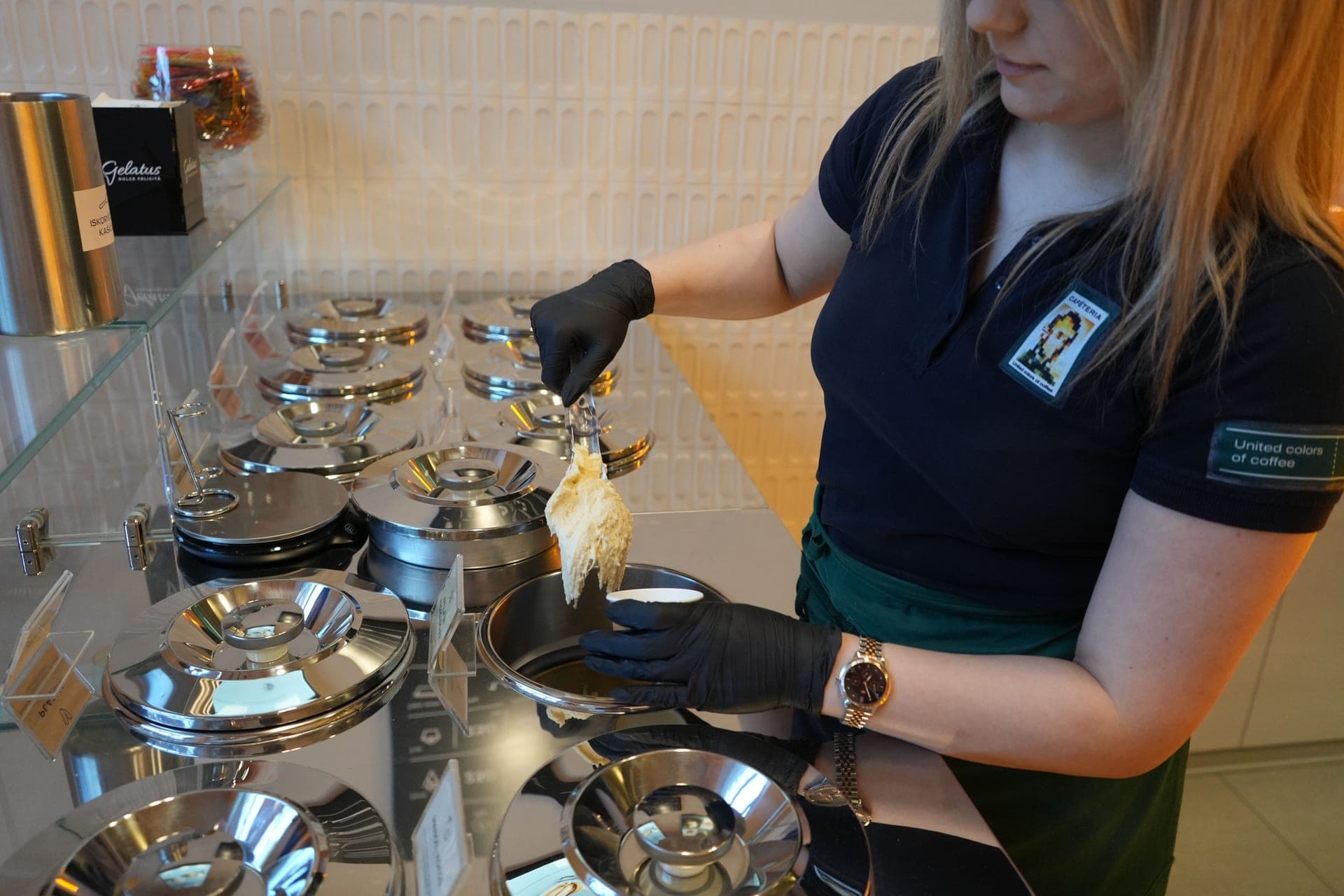
Gelato is served around 10 to 15 degrees Fahrenheit warmer than American ice cream, which is why a gelateria serves it soft from a covered case with a spade rather than hard from a tub with a scoop.
You can demonstrate this for nothing. Take any homemade ice cream out of the freezer and let it stand ten to fifteen minutes before serving: it will taste stronger, sweeter and more like what it is flavored with. That is not your imagination, it is volatility. This is also why homemade ice cream is often described as too hard — it is lower in air than commercial product, so it eats harder at the same temperature. The fixes are in why homemade ice cream is too hard.
What does not distinguish them
The word. Gelato is simply Italian for ice cream. A tub labelled gelato in a supermarket may or may not have the low overrun and the fat profile described above; in the US the label is not a composition standard.
Eggs. Plenty of gelato contains no egg at all, and plenty of American ice cream is a cooked custard full of yolks. Egg is a thickener choice, and the two styles use it in both directions — see custard versus Philadelphia base.
Being healthier. Gelato has less fat per unit of volume and more actual dairy per unit of volume, and it is served in smaller portions. Whether that nets out in your favor depends entirely on how much you eat, and we are not going to pretend there is a clean answer.
What to look for in a machine that can do both
If you want genuine gelato texture rather than ice cream with an Italian name, the specification you are hunting for is control over air. In descending order of how directly a machine gives it to you:
- A second, low-air paddle. The most direct mechanism. A paddle shaped to move the mixture instead of whipping it puts less air in regardless of how long it runs.
- A fast freeze. The quicker the mixture sets, the less time the paddle has to aerate it. Freeze speed therefore does double duty: smaller crystals and lower overrun.
- A timer with auto shut-off. Overrun rises with churn time, so stopping at a known point is how you make the same gelato twice.
- A labelled gelato program. Useful, and the weakest of the four, because software cannot change a paddle's shape. Treat it as a reasonable default rather than a capability.
What does not help: program count, mix-in dispensers, hardness sensing. A machine advertising sixteen functions is advertising marketing. The mechanism that decides your dessert is how fast and how gently it freezes, which is also the argument in compressor versus freezer bowl.
The three machines that handle gelato properly
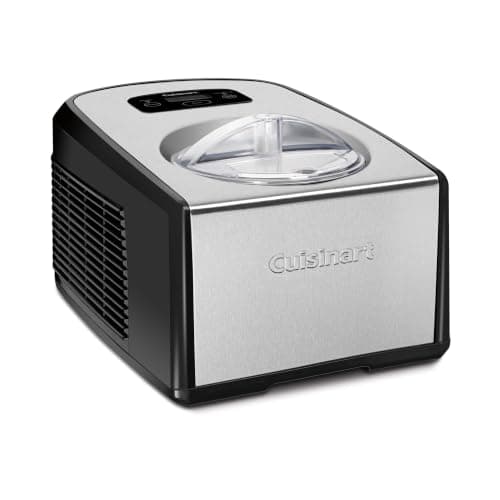
Cuisinart ICE-100. The clearest answer in the category, because it ships with two paddles and the gelato one is shaped to move rather than aerate. Dream Scoops singles out that ability to vary air content as an advantage, and it is the only machine we cover that gives you a mechanical choice. It is a compressor, so no pre-freeze and back-to-back batches, with a 60-minute timer and a 10-minute Keep Cool phase. The honest costs: America's Test Kitchen listed it at $343 in June 2026, it weighs 28 pounds and it is 16.73 inches deep, so it lives on the counter permanently.
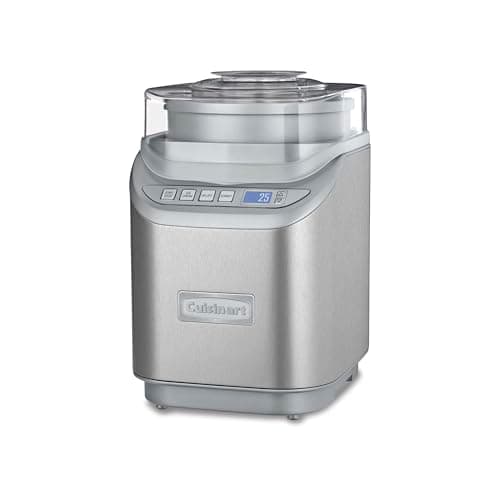
Cuisinart ICE-70P1. The budget route. Three texture programs, one of them gelato, plus an LCD countdown timer and auto shut-off, and Ice Cream Science rates its output the best of any canister machine it reviews. Against it: one paddle, a 16-to-24-hour pre-freeze, and a measured churn of 28 minutes 30 seconds, which is the slowest freeze we can cite. On gelato that slowness costs you more than it does on a fatty ice cream, so under-fill it — Ice Cream Science puts optimal fill at 900 milliliters against a 2-quart rating.
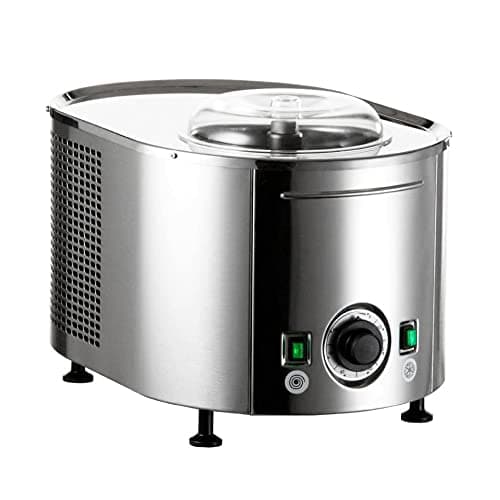
Lello 4080 Musso Lussino. Arrives at dense gelato from the other direction: one paddle and the fastest freeze anyone has measured, 17 minutes 30 seconds, with output Ice Cream Science describes as extremely smooth, dense and creamy after seven months of use. The problems are blunt — 38 pounds, a fixed bowl cleaned in place, a 700-milliliter optimal fill against its 1.5-quart rating, and a price Dream Scoops itself flags as the main drawback. The head-to-head is in ICE-100 versus Lello 4080.
A note on spin machines, which cheat in a useful way
A Ninja CREAMi does not churn a liquid at all — it shaves a block that is already frozen solid, which incorporates relatively little air by default. Structurally that is gelato-ish, and gelato is one of its named programs. It is a genuinely good way to get a dense dessert without buying a compressor.
What it will not give you is a gelateria's silkiness, because the texture comes from shaving rather than from freezing a liquid while it is agitated, and the output can come out crumbly on a first pass and need a re-spin. If that route appeals, start at how the CREAMi works, and if you want the machine ranking for gelato specifically it is in the gelato roundup.