If the point is for children to make the ice cream rather than wait for it, buy a hand-crank bucket machine — and start this weekend with a sandwich bag, which costs nothing. Every electric machine on this page makes better ice cream than a crank does. None of them gives a seven-year-old a job that lasts longer than ten seconds, and that is the thing you are actually shopping for.
So this page is not ranked on texture. It is ranked on how much of the process a child can legitimately own, with the honest trade named each time.
Do the free version first. Genuinely.
Before you spend anything, make ice cream in a bag on a Saturday. A sealed sandwich bag of base inside a bigger bag of ice and rock salt, shaken for about ten minutes. It is real ice cream, it costs almost nothing, and the shaking is the part children remember.
It also tells you which child you have. Some want to do the ten minutes of work; those are the children a crank machine is for. Some want the dessert and lose interest at minute two; for them a one-switch electric machine is the right purchase and a crank is a $200 argument waiting to happen. Spending $0 to find out which is the best value decision on this entire site.
What actually matters when children are involved
Four criteria, and they are not the ones a specification sheet leads with.
- A job a child can do. Cranking, packing ice, pouring the base, pressing one switch, choosing the mix-ins. Watching a motor is not a job.
- Nothing sharp in reach. Churning machines use a blunt plastic paddle that turns slowly inside a closed lid, which is about as benign as a kitchen appliance gets. Spin machines use a blade driven at 800 watts, and that is a different kind of machine.
- Mess you can tolerate. Ice-and-salt machines produce salt water that has to go somewhere. Outdoors or next to a sink, that is a feature. On a carpet it is not.
- Enough for everyone at the table. A birthday party is the single most common reason people shop this page, and most machines in the category make 1.5 quarts.
One safety note we will not soften
A Ninja CREAMi and the other spin machines drive a metal blade with an 800-watt motor into a pint that is frozen solid. They are safe when assembled and run by an adult, and they are not a machine to let a child load, unlock or reach into. If children are going to operate the machine themselves, that points at a crank or a canister machine, both of which turn a blunt paddle slowly behind a closed lid.
Why the crank machine wins a page it loses on paper
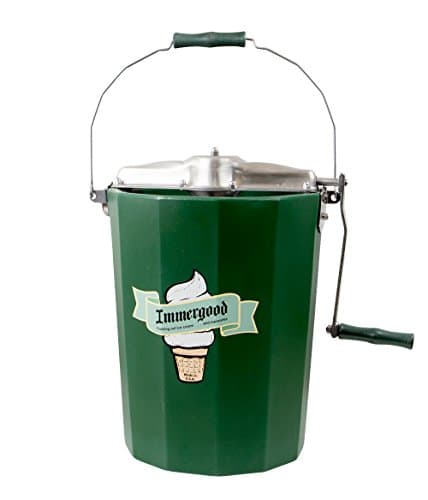
The Immergood 6-quart is stainless throughout, holds 6 quarts, and has no motor at all. You are the motor, which on this page is the entire proposition: twenty to forty minutes of real cranking that a group of children can take in turns, with the handle getting visibly harder as the ice cream sets. That resistance is the lesson. Nothing on a touchscreen does that.
Three honest problems. It is the most expensive way to buy 6 quarts of capacity on this site. Twenty to forty minutes of cranking is real work rather than a charming detail, and if the arms give out mid-batch the ice cream suffers. And we could not find independent test data on its output from any source we could read, so the texture claim here is the manufacturer's and the mechanism's, not a lab's. The same platform is sold with an electric drive and a cordless-drill drive, which is the honest fallback. More on the whole category in the hand-crank roundup.
The party machine, and the job it hands out
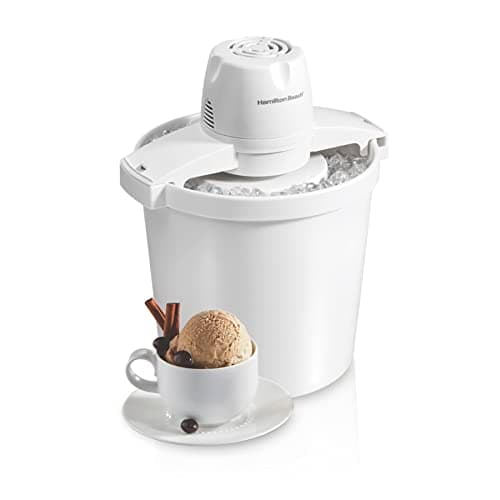
The Hamilton Beach 68330N makes 4 quarts in a single batch for less than most 1.5-quart machines cost, and its 80-watt motor stops itself when the mixture goes stiff. For a table of children that capacity is the whole argument: nobody is told the ice cream ran out.
It also hands children a genuine job without a blade anywhere near them. Packing the bucket in alternating layers of ice and rock salt takes a few minutes, needs no strength and is impossible to get seriously wrong. The costs are honest ones: you buy ice and rock salt every batch, there is salt water to drain, and it churns 20 to 40 minutes before the canister still wants a hardening spell in the freezer. Why the salt is there at all, and how much to use, is in how much salt an ice cream maker needs.
The machine most families should actually own
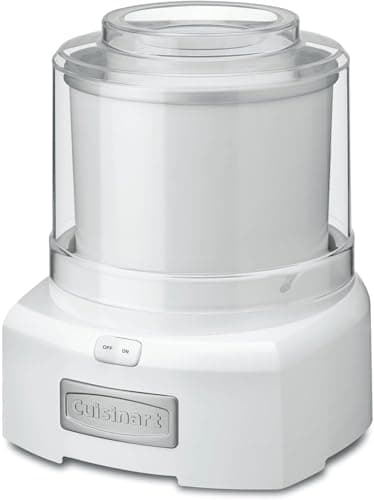
The Cuisinart ICE-21P1, at $70 in America's Test Kitchen's June 2026 review and their best canister-style pick. One switch, a blunt paddle inside a locked lid, 1.5 quarts, and a churn Dream Scoops measured at roughly 15 to 20 minutes. A child can pour the base in, lock the lid, press the switch and add mix-ins at the end, which is most of the ceremony for none of the mess.
Two caveats that matter specifically with children. The bowl needs 16 to 24 hours in the freezer, so ice cream is always a tomorrow decision — which is either a planning problem or a useful lesson in anticipation, depending on the household. And Dream Scoops measured it at 79 to 82 decibels, loud enough that a toddler may object. Keep the bowl in the freezer permanently and the planning problem mostly disappears; the longer version of that argument is in the beginner roundup.
One child, one pint, no leftovers
The DASH My Pint is a 12-watt freezer-bowl machine that takes up to a cup of mixture and returns about 1.6 cups finished, per the manufacturer. Two parts to wash, a bowl small enough to live in a freezer door, and a portion sized so nothing is left to go icy over three weeks. For one child making their own dessert on their own schedule, that is exactly right.
It is also the easiest machine here to over-buy. One cup in is one dessert, the bowl still has to be frozen first so the planning is unchanged, a 12-watt motor will stall on a very stiff mix, and we found no independent test data on it. Two of these cost more than one ICE-21P1 that makes eight times as much. Buy it for one child, not for a family.
The wooden bucket, bought for what it is
The Nostalgia ICMP600WD is 6 quarts in a real wood bucket with an aluminum canister, a 50-watt motor and a clear lid children can watch through. It is bought for the occasion as much as the ice cream, and we would rather say that than pretend otherwise.
What you are accepting: ice and rock salt in larger quantities than a 4-quart machine, no independent test data from any source we could read, a bucket that wants drying properly afterwards, and six quarts of cream to commit to in one go. For a family reunion that is the right machine. For a Tuesday it is not.
What to skip, and the flavor that wins the room
Skip anything whose selling point is a program menu. A machine advertising sixteen functions is advertising marketing, and no menu changes the one thing that decides your ice cream, which is how fast the mixture freezes while it is being stirred. Skip single-serving machines for a household of four. And skip the assumption that children want unusual flavors: they want vanilla and chocolate, and the no-fail vanilla is the batch to start with because it is the one that goes wrong least.
Two practical notes for a first batch with children. Chill the base thoroughly in the fridge first — a warm base is the most common cause of icy homemade ice cream, and nothing deflates a child faster. And add mix-ins in the last minute or two of churning, not at the start, or they sink and bruise the paddle. If you want the whole sequence written out, start at how to make ice cream at home.
So which one
- Children who want to do the work: the Immergood 6-quart crank. Expensive, and the only machine where the churning is the point.
- Parties and a crowd: the Hamilton Beach 68330N. Cheapest capacity here, and packing the ice is a real job.
- Normal family weeks: the Cuisinart ICE-21P1. One switch and nothing to learn.
- One child, their own portions: the DASH My Pint.
- Not sure yet: ice cream in a bag, this weekend, for nothing.