Buy the Cuisinart ICE-100 if you want a quart and a half of ice cream this evening without having planned for it. Buy the Ninja CREAMi if you want single pints, on demand, from a freezer you stocked last week. Those are not two answers to the same question, which is why this comparison is more useful than the price difference suggests.
Side by side
| Spec | 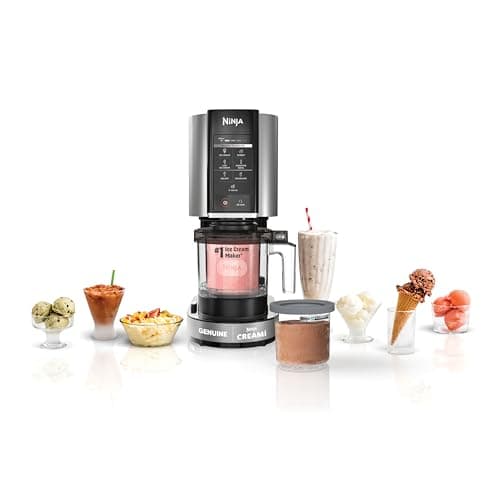 | 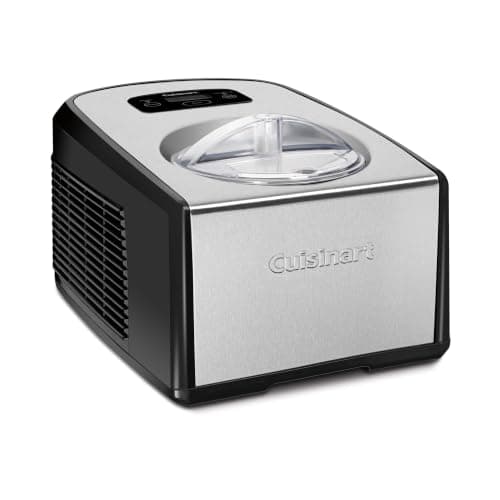 |
|---|---|---|
| Mechanism | Shaves a frozen-solid block | Refrigerates and churns liquid |
| Pre-freeze | Pint frozen overnight | None |
| Batch size | 16 oz per pint | 1.5 qt |
| Working capacity | 0.5 qt per pint (ATK) | 1.5 qt rated |
| Back-to-back batches | Yes, one pint at a time | Yes, continuously |
| ATK June 2026 | Recommended with Reservations, $207 | Recommended, $343 |
| Air control | Low by default, not adjustable | Two paddles, ice cream or gelato |
| Power | 800 W | 288 W |
| Size | 17.44" L x 8.58" W x 18.39" H | 12" W x 16.73" D x 9.33" H |
| Freezer space needed | One slot per pint, permanently | None |
| Price |
These machines do not do the same thing
The CREAMi is not an ice cream maker in the churning sense. You blend a base, freeze the pint solid for 24 hours, then an 800-watt motor drives a blade down through the block and shaves it into something scoopable. Nothing in the machine gets cold. Your freezer is the refrigeration.
The ICE-100 has a compressor in it. It chills the bowl while the paddle turns, which means you can decide on ice cream at seven and eat it at eight, and then make a second flavor immediately afterwards because nothing needs to recover. That is the only mechanism in the category that delivers spontaneity, and the reason it costs what it does. The compressor versus freezer bowl guide has the longer version.
So the shorthand “the Creami is cheaper” is true and almost irrelevant. ATK listed the CREAMi at $207 and the ICE-100 at $343 in their June 2026 review. That gap buys a different workflow, not a discount on the same one.
The planning question settles most of it
Ask one thing: do you want dessert tonight, or do you want dessert available?
Dessert tonight means the ICE-100. No bowl to pre-freeze, no pint to freeze overnight, 1.5 quarts in one go, and a 60-minute countdown with a 10-minute Keep Cool so it does not over-churn while you finish dinner.
Dessert available means the CREAMi. Spend a Sunday blending four pints, stack them in the freezer, and for the next two weeks ice cream is a three-minute decision. Ice Cream Science spent ten weeks with one and came away positive on exactly that convenience, and Taste of Home's review makes the same point about the made-ahead workflow. The catch is arithmetic: one 16-ounce pint per spin. Four people eating means four pints frozen in advance, which is a real amount of freezer space.
The capacity comparison is wider than it looks
America's Test Kitchen records the CREAMi's working capacity as 0.5 quart per pint against the ICE-100's 1.5 quarts. But the CREAMi makes that half-quart one pint at a time, while the Cuisinart makes its quart and a half as a single batch you serve from a tub. For a family that is a three-to-one difference in practice and a difference in kind: four pints is four separate spins, four lids and four flavors, whereas one tub is one scoop and go.
Texture: different problems, not better and worse
Both machines can produce very good ice cream and they fail in opposite directions.
The CREAMi's failure mode is crumbliness. Shaving a block that is frozen rock-solid gives you a powdery first pass, which is what the re-spin function exists to fix, along with letting the pint temper for a few minutes before processing. That is a technique problem with known answers, laid out in grainy or crumbly ice cream.
The ICE-100's failure mode is the classic churning one: too much air, or too slow a freeze if you fill it to the brim. Its answer is mechanical and unusual — two paddles, one for ice cream and one for gelato, so you choose how much air goes in. Dream Scoops singles out that ability to vary air content and calls the machine the best value alternative to a several-hundred-dollar Italian machine. Nothing in the CREAMi line gives you that choice; it is low-air by default and you take what the blade gives you. See overrun explained.
One genuine advantage worth naming for the CREAMi: it handles bases that stall a churning machine. High-protein mixes, very low-sugar mixes and whole-fruit purees are all easier to process as a frozen block than as a liquid that has to stay fluid around a paddle. If protein ice cream is the reason you are shopping, the CREAMi is the right machine and the protein roundup explains why. The same logic is why the frozen-block machines compete well on sorbet, covered in the sorbet roundup.
Where each one lives
Neither of these is a cupboard appliance, and they are awkward in different ways. The CREAMi NC301 is 18.39 inches tall, which will not clear a standard wall cabinet, so it either lives on an open stretch of counter or comes out and goes back each time. The ICE-100 is shorter but 16.73 inches deep and 28 pounds, which in practice means it stays where you put it.
Then there is the freezer side of the ledger, which buyers consistently underestimate. The ICE-100 needs no freezer space at all to be ready. The CREAMi needs as much freezer space as the number of pints you want available, every day, permanently. If your freezer is already full, that is the deciding fact and not the counter.
Running cost and what each batch is worth
Per batch the two are closer than the purchase prices imply, because a pint of base and a quart of base cost roughly in proportion and both machines are cheap to run. What differs is waste. A single pint spun and eaten the same evening has no leftovers to go icy; a 1.5-quart tub has plenty, and how you store it decides whether batch two tastes like batch one. Both sides of that trade are in cost per batch and storing homemade ice cream.
The verdict, by household
One or two people: CREAMi. Pint portions genuinely fit the way you eat, the price is lower, and the made-ahead workflow turns out to be a feature rather than a chore once the freezer is stocked. Which model to buy is a separate question, answered in which Ninja Creami should you buy.
Three or more, or any kind of entertaining: ICE-100. One batch feeds the table, you can run a second immediately, and nothing has to be decided the day before. Full detail in the ICE-100 review, and the alternatives at this price are in the compressor roundup.
Neither, for many people. If you are choosing between these two because you want good homemade ice cream and are not committed to either workflow, a $70 freezer-bowl machine makes 1.5 quarts and asks only for a bowl in the freezer. That trade is laid out in Creami versus a traditional ice cream maker, and it is the recommendation most first-time buyers should take.