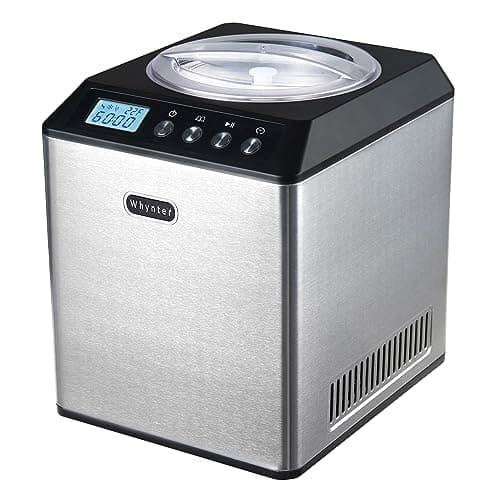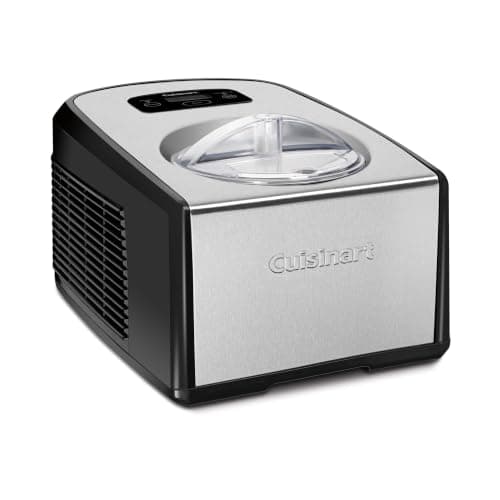
For almost everyone, the CREAMi. Not because it is the better machine in the abstract — it is not a churning machine at all — but because the Smart Scoop costs roughly three times as much and the two most useful independent assessments of it disagree with each other about the one thing you are paying for. That is an uncomfortable position for a $600 appliance, and this page is mostly about why.
Side by side
| Spec | 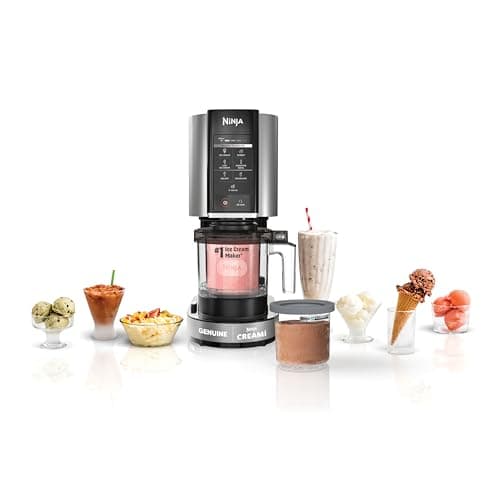 | 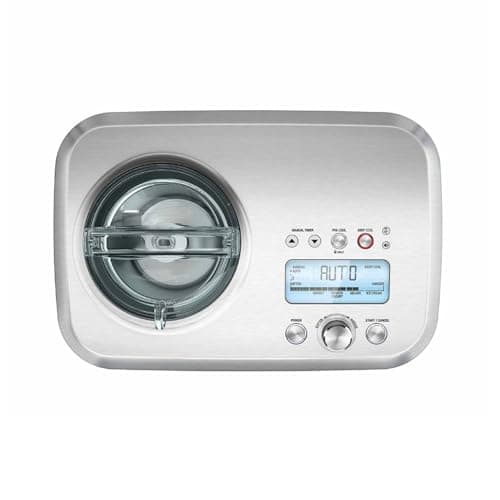 |
|---|---|---|
| Mechanism | Shaves a frozen-solid block | Refrigerates and churns liquid |
| Pre-freeze | Tub frozen overnight | None |
| Batch size | 16 oz per pint | 1.5 qt |
| Working capacity | 0.5 qt per pint (ATK) | 1.5 qt rated |
| Texture control | Re-spin button | 12 hardness settings |
| Tells you when it is done | No, programs run to time | Yes, audible alert |
| Power | 800 W | 150 W |
| Weight | Not published by Ninja | 30 lb 9 oz |
| Warranty | 1 year | 1 year |
| ATK verdict (June 2026) | Recommended with reservations, $207 | Recommended, $600 |
| Price |
These are not two versions of the same appliance
Everything else on this page follows from the first row of that table. The Breville is a conventional ice cream maker with a refrigeration circuit in the base: you pour liquid in, a compressor chills the bowl, a paddle churns, and in half an hour or so you have a quart and a half of ice cream you did not plan for. The CREAMi does not churn anything. You freeze a tub solid for roughly 24 hours, then a blade mills the block into something scoopable. Our how the CREAMi works page covers that sequence, and compressor versus freezer bowl covers the broader mechanical split.
The practical difference is when you decide. With the Breville you decide at seven and eat at eight. With the CREAMi you decide on Tuesday and eat on Wednesday — but you can keep six tubs frozen, which means six flavors on standby rather than one batch at a time. Neither is strictly more convenient. They are convenient at different moments.
The expert disagreement you are buying into at $600
America's Test Kitchen recommended the Smart Scoop in its June 2026 equipment review, at a listed $600. Dream Scoops, whose compressor-machine comparison we cite throughout this site, advises against it: their testing reported it took considerably longer to freeze than any other machine they tried, and produced coarser, wetter, icier ice cream as a result.
We are not going to adjudicate that, because we do not run a testing lab — our methodology page is explicit that our scores are editorial judgments built on published testing, not measurements of our own. What we will say is what the disagreement means for a buyer. It is over texture, which is the only thing a $600 machine can justify its price with. A slow freeze means bigger ice crystals, which is precisely the mechanism behind icy homemade ice cream. If Dream Scoops is right, you have paid a premium for the problem the premium was supposed to solve.
By contrast, the CREAMi's independent record is mixed but not contradictory. ATK put it in Recommended with Reservations at $207, and the reservation is capacity, not texture — one 16-ounce pint per spin. Ice Cream Science lived with one for ten weeks and came away positive on convenience and footprint. Taste of Home reviewed it favorably. Nobody says it makes bad ice cream; the honest complaint is that it makes a small amount of it at a time.
What $600 actually buys you here
Twelve hardness settings and an alert when the machine reaches the one you chose. That is a real feature and no other machine on this site has it: you can take the same base to soft serve or to hard scoop on demand, which is genuinely useful if you serve dessert to people with different preferences. Whether it is worth roughly $400 more than a CREAMi, or roughly $290 more than the Whynter ICM-201SB that won ATK's self-refrigerating pick at $310, is the question this page exists to make you ask.
Capacity: the CREAMi's real weakness
If you are feeding four people, the Breville wins outright and it is not close. One 1.5-quart batch serves a table; four CREAMi pints means four tubs frozen two days ahead and four separate spins while everyone waits. ATK recorded the CREAMi's working capacity at half a quart, and no amount of freezer stocking changes the fact that the machine processes one tub at a time.
The partial answer is the XL Deluxe line, which takes 24-ounce tubs instead of 16-ounce pints — see our XL Deluxe Gen 2 review. That is half again as much per spin, but it is still one tub per spin, and it still costs well under half a Smart Scoop. If capacity is the binding constraint, read the best ice cream makers for a family before you buy either machine here, because there are cheaper routes to a quart and a half than a $600 compressor.
Counter space, freezer space and noise
The Breville is 30 pounds 9 ounces and 16 inches wide. That is a permanent counter resident, not an appliance you lift out of a cupboard, and it is the single most common regret with any compressor machine. The CREAMi is lighter but tall — 18.39 inches on the NC301, which will not fit under a standard wall cabinet, so it needs an open stretch of counter or a shelf.
The hidden cost on the CREAMi side is freezer space. The workflow only pays off if you keep tubs frozen, and tubs in the freezer are tubs of air as much as dessert. In a holiday-house freezer already full of other people's food, that is a real constraint and worth thinking about honestly before you buy four extra pints. Our storing homemade ice cream guide covers how to do it without losing texture.
What each one is actually good at
The CREAMi is unusually good at the bases that defeat churning machines. High-protein mixtures and non-dairy bases freeze hard and churn badly, but a blade shaving a frozen block does not care about fat content — which is why the CREAMi dominates the protein-ice-cream world and why our protein machine roundup leads with it. It is also the better machine for sorbet-style mixtures with no dairy at all.
The Breville is better at the thing a churning machine is for: a rich, custard-based ice cream with air worked into it over half an hour. Its hardness settings are most useful on exactly that kind of base. If you want the classic texture — and custard versus Philadelphia base explains what that means — a churning machine is the right tool and the CREAMi is an approximation of it.
The verdict, and the machine that beats both
Buy the CREAMi if you are one or two people, you are happy to decide the night before, and you want flavors on standby rather than batches on demand. It is a third of the price, its weaknesses are well documented and none of them is texture, and you can buy extra tubs for the cost of a takeaway. Our full CREAMi review is the next page to read.
Buy the Smart Scoop only if the twelve hardness settings are specifically what you want, you serve dessert to people with different texture preferences, and you have read the Dream Scoops finding and decided it does not worry you. Our Smart Scoop review lays out both expert positions in detail.
Buy neither if what you actually want is a quart and a half of ice cream this evening at a sane price. In that case the machine to look at is the Cuisinart ICE-100 — a compressor machine with a three-year warranty and a second low-air gelato paddle, at a fraction of the Breville's price — or the Whynter ICM-201SB, which took ATK's best self-refrigerating pick with 2.1 quarts and no pre-freeze. Both appear in the compressor roundup, and the head-to-head is Smart Scoop versus ICE-100.