
Buy the Whynter ICM-201SB if more than two people are eating, and the Ninja CREAMi if you want several flavors ready or you make high-protein and low-sugar bases. America's Test Kitchen rated both in its June 2026 review: the Whynter was its best self-refrigerating machine at $310, the CREAMi sat in Recommended with Reservations at $207. The price gap is small. The capability gap is not.
Side by side
| Spec | 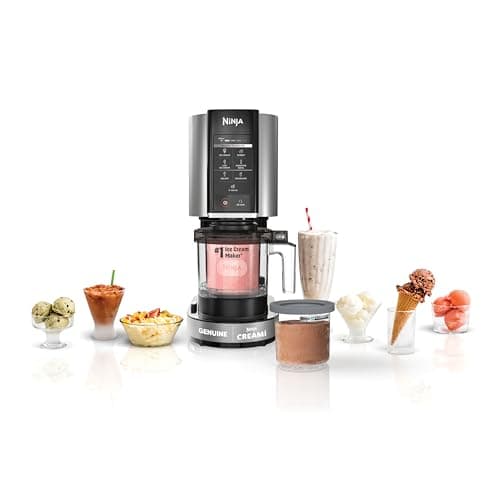 | 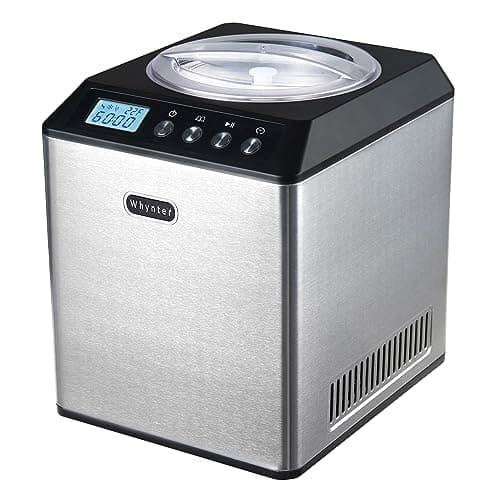 |
|---|---|---|
| Mechanism | Shaves a frozen-solid pint | Churns liquid with a compressor |
| ATK June 2026 | Recommended with Reservations, $207 | Best self-refrigerating, $310 |
| Capacity per run | 16 oz pint (0.5 qt per ATK) | 2.1 qt |
| Planning needed | Pint frozen overnight | None |
| Back-to-back runs | Yes, if more pints are frozen | Yes |
| Programs | 7 one-touch | Single churn, no programs |
| Power | 800 W | 180 W |
| Rated noise | Not published | 60 dBA or less (manufacturer) |
| Bowl | Pints, dishwasher safe | Removable stainless |
| Height | 18.39" | 14.25" |
| Weight | Counter-resident | 24.25 lb |
| Protein / low-sugar bases | Handles them | Stalls the paddle |
| Price |
These are not two versions of the same machine
The Whynter is a conventional ice cream maker with its own refrigeration unit. You pour in a chilled liquid base, it freezes the bowl continuously while a paddle turns, and 2.1 quarts of ice cream comes out. No pre-freeze, no gel bowl, no waiting — the largest no-wait capacity of anything ATK rated.
The CREAMi does not churn anything. You blend a base into a pint, freeze it solid, and an 800-watt motor drives a blade down through the frozen block, shaving it into something with the texture of ice cream. That is a genuinely different process with genuinely different consequences, which is why CREAMi versus a conventional ice cream maker is worth reading if this is the first time you have met the distinction.
Capacity is the first and biggest divide
2.1 quarts against 16 ounces is roughly four to one. Put concretely: the Whynter makes one batch that serves eight or nine people from a decision you make at six o'clock. The CREAMi makes one pint, which is two servings, from a pint you froze last night.
You can scale the CREAMi by owning more pints, and that genuinely works — spare pints are the accessory that fixes its real limitation, and CREAMi pints and accessories covers it. What you cannot do is scale it on the night. Four people means four pints frozen in advance and four spins, each needing its own trip through the machine. For a dinner party that is not a workflow.
The planning question, answered honestly for both
People buy the CREAMi believing it removes the 24-hour wait. It does not: the pint has to freeze solid, which is the same overnight commitment a gel bowl wants. What it changes is when you do the planning — once per flavor, not once per dessert, so a stocked freezer feels spontaneous. The Whynter genuinely removes the wait: there is nothing to freeze in advance at all. If true impulse matters, that difference is decisive.
What only the CREAMi can do
Two things, and they are the reason it is on this page rather than being dismissed on capacity.
Bases a churning paddle cannot handle. High-protein and low-sugar mixtures behave badly in a churn: without enough fat and sugar they set into a stiff mass that stalls a small paddle, and what you get is coarse. Shaving a frozen block does not care about any of that, which is why the CREAMi owns the protein-ice-cream category outright — see the protein ice cream roundup.
Several flavors at once. Seven one-touch programs cover sorbet, gelato, milkshake, smoothie bowl and lite ice cream, and each pint is its own flavor. A Whynter makes one flavor per churn, and while it can run batches back to back, you are still washing the bowl between them. Ice Cream Science spent ten weeks with the CREAMi and came away positive on exactly this convenience, plus its footprint.
What only the Whynter can do
Serve a table from a liquid base in one go. That is the whole conventional ice cream maker proposition and the Whynter is ATK's best execution of it, at 2.1 quarts in a 14.25-inch-tall upright that takes less counter depth than the Cuisinart ICE-100.
It also wins on three practical details the specification sheets bury. The removable stainless bowl lifts out and goes to the sink, which no fixed-bowl compressor allows and which is why it leads the easiest-to-clean roundup. It is rated 60 dBA or less by Whynter, one of only two published noise figures in the entire category, against an unpublished figure for an 800-watt blade machine. And it draws 180 watts rather than 800, which tells you how much less violence is involved.
The honest problems: $310, 24.25 pounds, no gelato-specific paddle, and Dream Scoops rated a different and smaller Whynter poorly on build quality — not this model, but worth knowing. Full detail in the ICM-201SB review.
Texture: a real difference, not a marketing one
A compressor machine incorporates air while it churns, which is what makes ice cream scoopable and light. A CREAMi shaves a block, which incorporates relatively little air by default — structurally closer to gelato or sorbet. Neither is better; they are different desserts, and overrun explained is the page that makes sense of it.
The practical consequence is that CREAMi output can come out crumbly on the first spin and needs a re-spin with a splash of milk, which is a step people are not told about before they buy. The Whynter has no equivalent failure mode. The CREAMi's known weak points are collected in the CREAMi downsides page.
The verdict, by household
- Four or more people, dessert served at a table: Whynter ICM-201SB. The CREAMi cannot do this evening's dessert for six at any price.
- One or two people, several flavors, most nights: Ninja CREAMi, plus spare pints. See the best machines for two people.
- High-protein or low-sugar bases: CREAMi, and it is not close. No churning machine handles those well.
- Truly spontaneous, no freezer planning at all: Whynter. It is the only one of the two with nothing to freeze in advance.
- Quiet kitchen, easy washing up: Whynter, on the removable bowl and the only published decibel rating of the pair.
If the budget is the problem rather than the choice, note that a $70 Cuisinart ICE-21P1 was ATK's best canister-style pick in the same review and makes 1.5 quarts for a fifth of the Whynter's price, as long as you will keep a bowl in the freezer. That trade is laid out in compressor versus freezer bowl.